Saturday, 19 March 2016

Where has courtesy gone?

Dragon Dad and I headed over to our nearest beach suburb for coffee, food and the papers today - something we do often on weekends. While Saturdays have officially been Sydney's worst day on the roads for some time now (especially in term time, due to school sports...) he and I were fairly rattled by the time we'd gone there and back - not by the volume of cars on the road, but due to the lack of courtesy evident in so many drivers.

There was the empty bus with the driver who clearly wasn't wasting any time getting wherever he was going - he wasn't on an actual bus route, and he was pushing the envelope as far as the speed limit was concerned. Not only that, he wasn't being particularly careful of his bulk as he ducked and weaved around the cars he was sharing the road with - if ANY of them had done anything unexpected, I suspect they'd have been collected by the bus. 

We were heading towards a large intersection at one point on the way home when the lights went amber, so Dragon Dad slowed and pulled up at the lights - as is correct. That amber light DOESN'T mean hit the accelerator and speed up so you can beat the lights. It means slow down and STOP unless you absolutely can't do that safely. That doesn't appear to be how most Sydney drivers understand that particular road rule though - as I said to Dragon Dad today, my feeling lately is that it's only a matter of time before I have someone rear end me. The number of times I've been slowing down for an amber light and have suddenly become aware of the vehicle behind me screaming to a halt just before hitting me is starting to mount up. I can only hope I'm in Dragon Dad's Subaru when it happens, rather than my Barina...and that my already twice injured neck survives another whiplash... 


Then, two houses away from turning back into our own driveway, we narrowly avoided being clipped by the woman impatient to turn across us in her four wheel drive, who then, once we were out of her way, turned in FRONT of the oncoming bus that we'd passed (correctly...). 

While inherently dangerous, all of these driving behaviours are linked by a common lack of basic courtesy. The woman in the four wheel drive was being impatient - it was required, by law, that she wait for the buss to turn. Clearly, she wasn't prepared to do that. Maybe she doesn't like driving behind a bus. Maybe she had somewhere to be and was in a hurry. Whatever the reason, her lack of courtesy meant that she put others at risk. As did the buss driver, as are the drivers in all the cars that are burning rubber to stop behind me when they realise at the last minute that I have no intention of running the lights, so that means they can't either.

When my mother learned to drive - very late in life after we moved from Sydney to a small country town and no driver's license meant no mobility because there wasn't public transport - her instructor was rabid about 'not embarrassing other drivers'. i.e. NOT putting other drivers at risk by your own behaviour in a car. 

While I've used vehicular examples because of the string of events we experienced today, it's part of a larger symptom that I see is ailing wider society today. Courtesy is more than just basic good manners. Courtesy is about being considerate of other people, thinking about them and your effect on them. It's not something that is widely taught any more, and it's not something that comes naturally. Those drivers today were evidence of the effects a lack of courtesy and an inflated sense of self absorption can have on road safety, and it doesn't take much to transfer those concepts to other areas of daily life.

Call me old fashioned - well, I am in many respects, but unlike many, I don't see that as a negative - but I think that people underestimate the damage a lack of courtesy can do in the daily interactions we have with others. Lack of driver courtesy coulds certainly do ME a stack of damage if one of those discouteous drivers DOES rear-end me...

Friday, 18 March 2016

Why I hate all the fad diets...


This piece was originally posted on Creaky Joints last year, and explains a lot of why I loathe all the faddy diets that are out there, and provides a bit more context for my post earlier this week about starting the 5:2 regime to try and lose the weight I haven't been able to shift, despite a basically healthy diet. 

Dragon Dad’s chiropractor, when DD asked if there was anything he felt he could do that might be useful for me with my rheumatoid arthritis: “Well, it all starts with diet. She shouldn’t be eating any nightshades, wheat, dairy or drinking any red wine. They all cause inflammation.”

A well meaning, but ill-informed friend: “I have a friend who’s vegan, and he says if you eat vegan, your RA will be cured.”

From another friend: “I hear that the paleo diet is doing great things for people – maybe if you ate paleo, you’d get better.”

And then there’s the friend who’s both vegan and anti Western medicine, who keeps sending me stuff about diets and alternative medicines, via email, Facebook, and whenever we actually see each other – which means he says all sorts of negative things about my skim milk latte…among other things!
And so on…and on….and ON…

I’ve had RA for twenty-three years now. I didn’t ask to be sick. I don’t like being sick. I’ve been a compliant patient. I’ve also tried all sorts of ‘diets’, because why the hell wouldn’t I, if there was a chance they might help?

Now that my RA is no longer mild, I’ve had a whole bunch of people come out of the woodwork and have another go at converting me to this or that ‘miracle’ diet. Then I got diagnosed with IBS (Irritable Bowel Syndrome) as well, and had the gastroenterologist telling me that he’d like me to try the FODMAP diet. I sat reading the list of ‘forbidden’ foods on his printout, and my stomach sank…

You see Dragon Dad is a bit of a fitness nut. He was an elite athlete and has never really lost the drive to be as fit and strong as possible. These days, that is mostly focused on cycling, and he’s taken up endurance riding, after a career as a track cyclist. Part of his motivation to get back on the bike was that he’d decided he’d got a bit heavier than he wanted to be, and coming up to his 40th birthday, he decided that he HAD to lose weight. He tends to pick up on the latest diet fads pretty quickly and it can all get a bit extreme. So he began a series of different diet plans, all designed to work miracles, so by default, I ended up eating them alongside him.

That meant I got to try paleo, and another one that was very similar but more restrictive (I can’t remember what that was called), and then there was the whole delete ALL carbs thing. It didn’t help that I’d stacked on the weight, courtesy of prednisone, so I also wanted to lose weight, so I let myself be dragged willy-nilly along with him.

Here’s the thing: NONE of those diets have changed a darned thing about my RA. Not one of them. Not even a little bit. In fact, some of them seemed to exacerbate certain things – paleo, for instance, given that since my year as a vegetarian I don’t eat a lot of meat any more, left me with constant indigestion, and gut upsets. The fact that it was remarkably similar to what was allowed on the FODMAP diet my gastroenterologist had strongly suggested concerned me enormously.

Eventually, I got fed up. I got SO tired of being told what to eat by every second person I encountered. WHAT is it about being sick makes people think they have a right to tell you what to do, in a way I’m sure they don’t with well people?!
I went back to eating instinctively. I calculated a reasonable average calorie allowance per day that would help with weight loss, allowing for my fluctuating ability to exercise. I ate within that. I ate my toast for breakfast – a boutique bakery bread with soy beans and quinoa that’s low GI and gives me a massive protein hit, regardless of what I put on it. I kept eating pulses and other grains that also help me maintain a healthy protein intake, even though I don’t eat a lot of meat. I kept up my dairy, because I’m a milk drinker, I love cheese and yogurt, and I DON’T want to add osteoporosis to my list of diagnoses. And, I kept racking up enormous bills at the greengrocer – bigger sometimes than the supermarket bill. I don’t eat junk food – I don’t like it. I don’t have a sweet tooth, so my sugar intake is well balanced. I DO eat chocolate – not much, and when I do it’s good quality dark chocolate. I do indulge in a moderate amount of alcohol occasionally. Without intending to, my regular eating plan is probably closest to what’s being marketed as the Mediterranean Diet.

My RA got NO worse. OMG – I’m eating dairy, some red meat, wheat (GLUTEN…), and what do you know, my RA hasn’t lost the plot! My IBS got better – I still have flare ups with that, but they’re milder and of shorter duration.

There are a LOT of articles out there pushing this or that diet at chronically ill people. Most of those articles call for you to buy a book or DVD to learn more. Most of them tell us that if we adhere to the diet, religiously, we’ll be cured.
Don’t believe it.

Some people DO find that certain symptoms ease if they eat a particular way. It could be that without knowing it, they had sensitivities to some things and eliminating them has helped them feel better.

In conversations with some people, I found out that prior to really looking at their food, they’d been eating a lot of packaged, and pre-prepared foods, so cutting those out had made an enormous difference to how they were feeling – which made sense, since they were no longer eating all the preservatives and other additives, let alone the amount of salt and sugar. Convenience aside, I can’t honestly see how all that stuff could ever make you feel good!

My bottom line, after all my experiences with different diets, has been that there is no one way that works the same for everyone. For me, what works is to eat fresh, local, seasonal produce. Leave the packets on the supermarket shelves. Eat small meals – so many of us eat WAY more than is necessary. Drink lots of water. DON’T eliminate whole food groups unless you have a sound medical reason to do so – ie, eliminating gluten if you’re a diagnosed Celiac. And, most importantly of all, listen to your body. Pay attention to the times you feel bad after eating, and see if there’s something that regularly upsets you and drop that from your diet. That makes much more sense to me than listening to a bunch of people pushing extreme diets who are, more than anything else, out to make money.

Wednesday, 16 March 2016

The 5:2 fasting regime

So, crunch time. Courtesy of Michael Mosely appearing on an SBS Insight special about diabetes 2, I have finally mustered up the motivation to do something about my drug acquired kilos. I watched and listened as the people in the audience contributed their stories about diabetes 2, and realised that while I'm not even medically pre-diabetic, those unwanted kilos potentially put me at risk, and adding ANOTHER thing to have to deal with is just not to be thought about...

There were various solutions and treatments discussed, but the main thing is to get excess weight off, and KEEP it off. It really does appear to be more of a lifestyle disease than anything else, although it became clear in the discussion that different cultural groups tend to have more or less propensity to acquire it. 

I spent years fighting to keep weight ON, due to a massively over-efficient metabolism. It didn't matter what or how much I ate, I was a tall skinny type lacking curves. I look back on that and yearn for the ease of it, now, and the lack of worry... The combination of the pain levels I sometimes have to deal with courtesy of my RA that restrict my ability to exercise regularly, and side effects from some of the necessary medications have added twenty kilos (at least) to my very fine frame, and diabetes panics aside, that's just too much weight for me to be carrying. Apart from anything else, I can't afford to replace my wardrobe - and as shallow as that might sound, it IS a consideration! One of the subsequent issues for me though is that I don't do well on diets. I'm not used to having to calculate food and calories, it bores me, and I can't maintain what feels like so many restrictions. 

I first discovered the 5:2 fasting plan on a special Michael Mosely made that aired on SBS TV some time ago. He was exploring all sorts of different types of fasting, from the extreme to mild. I'm no stranger to fasting - until I was stuck with drugs that have to be taken with food, I fasted for Yom Kippur (the  Jewish Day of Atonement) every year, which is a 26 hour fast, eating and drinking nothing at all. Fasting for health reasons wouldn't have occurred to me. What struck me about the 5:2 plan is how potentially sustainable it is. 

Basically, for those who don't know, it's based on eating within a normal calorie range (2000 calories for women, 2500 for men) for five days of the week, and cutting that down to a quarter of that allowance for two days a week. So, it's not, as Dragon Dad (who's currently on a 1500 calorie regime for weight loss that makes NO sense to me, particularly as he's training like a maniac) railed at me, 'starving myself', as I'm not NOT eating on the fast days, I'm just cutting right down. So, I can take my meds, and I end up drinking oodles of water - which is good for me, and makes up for not managing to regularly drinking enough water probably! I'm on week four now, and I have to say, I'm finding the fast days much easier than I thought they'd be, and each week they're easier to manage. 

My physio said to me yesterday that I look like I've lost some weight. As we don't own scales - and I don't want a set - I'm relying on how my clothes feel, and I have been aware, this week, that many things do feel less clingy.

For me, the best thing about this regime is that it IS sustainable. I'm not cutting out food groups, I'm not paying for expensive (and questionable) meal substitutes, I don't need a book or program, and I can basically eat what I like within my usual patterns of healthy eating - trimming that down quantity-wise on the fast days. Win win, really! Most of the people I've spoken to who've done it or are still doing it have been really positive, and very encouraging. Even with the limited exercise options that I can manage, I can still expect to slowly and steadily drop these damned unwanted kilos, and that will be excellent! It doesn't interfere with other people either - and come dinner time, Dragon Dad's 300 calorie dinners work just fine for me, because I've had a large skinny coffee and a small snack at breakfast time, so they're about the right size for me too, and we don't have to fuss with separate meals. It's the first time EVER that that's happened when there's been anything approaching a diet in this house!

Tuesday, 8 March 2016

Advocating/educating - why me?


This post was originally published on Creaky Joints. As the question about whether people with physical differences, disability and/or chronic illness should always be prepared to educate or be advocates for their condition/disease is still being batted around social media and other forums of discussion, I felt it pertinent to republish here. 

There seems, in my perusal of social media lately, to be a feeling in some sectors of the chronic illness ‘community’ to be an expectation that those of us with a chronic illness are required to be advocates and to educate people about our diseases. The two activities are different, and separate from one another, but that also seems to be a blurry distinction in the perception of many people I see writing and commenting on the issue.

I read a blog post recently by Australian blogger, Carly Findlay, describing an encounter she’d had on a bus – a stranger approached her while she was checking her phone and offered assistance, which was not required. Given that her condition, ichthyosis, has an obvious physical aspect, she read this as curiosity on the stranger’s part, and was annoyed. The comments on both the blog post and the Facebook page where she shared it included many from people who clearly felt she should have used the incident as an opportunity to educate the person. That’s only one example of the many that I’ve seen lately.

There seems to be an increasing pressure that somehow, by being sick, we all have an inherent responsibility to educate people about our illnesses and raise awareness whenever and wherever possible. I've been aware of it for some months, but recently, it seems to have resurfaced along with a great deal more discussion in various online groups to which I belong. While there may be many reasons for this, in Australia, a lot of the motivation for increased advocacy and education about illness and disability seems to be happening because, I think, there are far fewer institutionalised awareness programs. The national days/months for various illnesses come out of the U.S., and I’m seeing more people posting and using the colored ribbons that are part of those campaigns. Our own organisations exist as umbrellas for research and different resources pertaining to different diseases and conditions, but not so much for awareness campaigns.

Looking at my own Facebook wall, and thinking back over the years, I am realizing that I don’t talk much about my RA. There’s rarely anything specific to RA on my wall. I have two blogs (I write a book blog as well as this blog) and neither of them was set up to write about my life with RA. I do touch on RA sometimes here where it is relevant to the topic I’m exploring in a particular post, and I did participate in the #RABlog Week event using this blog as my platform. But it’s on Creaky Joints where I’ve been more writing specifically about it, because it is an appropriate platform for me to more fully explore issues around my experience with a chronic illness.

The thing is, my RA is not the sum total of who I am. It’s not the only thing in my life. It’s not even the main thing in my life. I don’t choose to be defined by my disease. Also, I’m not really the activist type. So, the idea of putting myself out there as a poster girl for RA feels really uncomfortable. I am many, many things. I have a lot of interests that I continue to try and maintain, so that despite having severe RA, I still have a life that is mine that I enjoy. 

I’m not willing to give that up. I also don’t think that being sick requires of me that I automatically become an advocate and RA educator. However, saying that also puts me in the firing line because there appears to be an attitude out there among some of the chronic illness ‘community’ that we should ALL be advocating and educating, ALL the time.

Frankly, I don’t feel that my illness is anyone else’s business except my own. To be honest, I find the grind of day to day living with RA quite tedious most of the time. It’s BORING being sick. REALLY boring. It interferes with my life in all sorts of ways, and makes keeping up with the things that really interest me (RA doesn’t – I’ve learned about that because I had no choice!) more challenging than I’d like a lot of the time. If it bores me, it stands to reason that me banging on about it at every opportunity that presents itself could well bore a whole lot of other people too. Why set out to do that?!

I don’t think, for a minute, that that advocacy and education shouldn’t be happening, and happening from a patient perspective. However, those of us who are sick and/or disabled represent a diverse collection of illnesses, personalities and abilities - reflective of the diversity of ANY community of people, disabled or not. Not all of us are suited to be effective advocates. As far as the majority of chronic illnesses are concerned too, the different presentations that there can be from individual to individual with RA can be enormous – and that’s just one disease… We may have commonality in the diagnosis, but the severity may differ, our personalities aren’t the same and that can affect how we deal with our disease, our drug protocols and how we react to different drugs can be very different, and our personal circumstances can range from single people to those with families, and of a range of ages. As one individual, I can’t be representative of that many people and that much difference. I certainly can’t be an adequate advocate for someone with diseases other than RA – I just don’t know enough about other diseases.

I’m perfectly willing, on an informal, one on one basis, to answer questions about RA, and to explain my reality of living with it, when and IF it comes up in a conversation. That’s how I feel I am most effective. Despite many years as a professional performer, I loathe public speaking and don’t do it well. I’ve been writing professionally for many years now too, but the writing I do about RA is personal, it’s about my experience, and that is not the same as the next person with RA, let alone those with a host of other illnesses. So going there as a writer would be a whole other ball game that, again, I don’t want to do. Also, while a lot of people I know might laugh at this, I’m shy. I’m not good at putting myself into public situations and being the focus of attention. If that statement appears to be at odds with me being here writing this, remember, I blog behind a pseudonym, and as a performer, I was hidden behind lots of stage makeup, wigs and costumes being a character. I wasn’t performing as myself.

I feel strongly that advocacy, like anything else in life, is a choice. For some of us it will be a choice that we DO become advocates for our illnesses. And that’s fine. There are many people out there doing just that and doing it brilliantly. For many, many more of us though, we won’t. There shouldn’t be an expectation or obligation there, and neither should there be any shaming for those of us who choose not to be active advocates.

Sunday, 6 March 2016

What's REALLY with inspiration porn?


This post was originally published on Creaky Joints. Just recently I came across an article by or about an artist with a disability (I can't remember which) which, to my annoyance now, I didn't bookmark, and search as I may through my computer history, I can't find. I do remember feeling very annoyed at the time of reading, as the artist concerned was asking for allowances to be made for them on the grounds of their disability. While I have had to deal with particular difficulties to make my art and/or perform, and that is happening now increasingly as the disease I have* gets worse, other than accessibility to studios, I don't want to ever find myself doing that, and feeling like that reminded me that I'd written this piece.

I am a musician and an artist. It’s what I do. It’s who I am. I’ve worked professionally as a singer and vocal teacher for most of my working life. As an artist, I’ve exhibited and sold ceramic work, drawings and paintings, taught art history and theory at college and university, and have won awards for my work.

When I was a kid, it became evident quite early on that I had gifts for music and art. My mother started me on piano lessons around the same time as I started school, and I have no memory of learning to read music, any more than I have of learning to read – they’re both things that just feel like I’ve always been able to do. There was a marvelous place near where we lived when I was small that had ‘stuff’ for kids to muck around with. There were kick wheels and clay, paints of all kinds, huge heavy sheets of paper, bins of timber offcuts, nails and hammers, scraps of leather and goodness only knows what else. We could make anything we wanted to, using any of the bits and pieces – it was heaven on a stick for a kid like me.

We moved interstate to a country town late in my primary (grade) school years. My piano lessons continued, and Mum had words with a woman who ran an oil painting class – for adults – at a local gallery, and they took me on even though I was only eleven or so. High school gave me access to a brand new fine art centre, and I rediscovered clay, learned about screen-printing, painted more and drew a lot. There was also an excellent music program, with a concert band and I started on clarinet, which I hated, and swapped to French Horn, which I loved, a year later. That landed me in a conservatorium after I finished school – art became a secondary thing for a while. I got conscripted into the chorus of a student opera in my second year at the Con, and then dumped into singing lessons by the head of the vocal school. Years later, I got work in the chorus of the State Opera Company in that state, and much later went on to art school, followed by an academic masters in art history.

That I have a disease that, at times – more frequently these days than otherwise – leaves me with a significant level of disability shouldn’t EVER be considered a factor in any of this – negatively or positively. There were times at art school when I was flaring that I struggled to get to upstairs studios, and would lose chalk and charcoal when my fingers gave way. It can be incredibly painful to stand and draw at an easel a lot of the time. I never told the bosses at the opera company that I had RA. They’d have probably seen me as a liability if I had, and as we were employed on a contract basis, I’d have been risking my job. The wardrobe mistress knew, and kept a pair of flat shoes for me to use whenever the costuming allowed for that. Otherwise, I just had to manage – and did, somehow, despite flares. Adrenaline is a marvelous ‘drug’. I could be struggling to get up the stairs to the wings, and then take a step out on stage, the adrenaline would kick in, and I’d feel no pain – until I stepped back into the wings again, to be caught by the stage manager as I collapsed, who also knew and helped wherever she could.

The thing is, I also didn’t want allowances made for me. I was in the opera company because my voice was good enough to sing professionally. I won awards and sold work in exhibitions because my work was judged on its merit and judged to be better than most. And that’s how I want it.

The trend of memes that Australian activist Stella Young coined ‘inspiration porn’ is something I find incredibly condescending. As are comments that what I do is somehow more special because I do it despite the challenges I face.

‘Inspiration porn’ is a term that has been coined by disabled people. It is when disabled people are referred to as ‘inspirational’ or ‘brave’ for doing ordinary things, just like non-disabled people. This issue is that it’s based on the assumption that someone with a disability has it so much worse than a non-disabled person.

In her Ted talk about this issue, I’m not your inspiration, thank you very much, Stella said we have been sold a lie; that disability is a bad thing, and to live with disability is exceptional. The constructed social environment perpetuates that lie via those memes. They objectify people with disabilities for the purpose of inspiring people without disabilities to make more of an effort and complain less about their lot – i.e. however bad my life is, it could be worse… She said that was bullshit. I agree with her. It is not exceptional that I do what I do, and continue to do it despite the growing difficulties. I do it because I must make art, and I must sing, because it’s just what I do. That I often have to push myself through pain and difficulties to achieve it has nothing to do with it – I do it because I MUST.

I was chatting on Facebook yesterday with a few people in the comments thread of a post where someone had posted another article about inspiration porn,  What Is so Wrong with Inspiration Porn?. While this post was particularly focused on events in American high schools that were especially created to allow students with disabilities to participate, rather than creating more generally accessible activities for everyone to do without the focus on the disabled students, our discussion was much more personal. One of the contributors, who is in a wheelchair, mentioned that she is involved in her local community centre, and makes bears. I take my hat off to her – I don’t have the patience for that kind of fiddly work! She also mentioned that she often gets told that it’s wonderful that ‘someone like her’ gets out and does this stuff, because she’s in a wheelchair. Her feeling is that there seems to be quite a bit of surprise from these people that someone with a disability is out there achieving something, or even anything – because somehow, a significant portion of the general public appear to think that that’s just not what happens. She is justifiably pleased when someone is taken by her work, and the years of skill acquisition behind it, but that feels diminished when the  reaction is tempered by their surprise. And that’s just so wrong.

Speaking for myself, because I can’t speak for others, that I have achieved what I’ve achieved is due to my talent and hard work. And having had the balls to put it out there in the public arena. For me, there is an enormous satisfaction in having achieved what I have. To have that framed within the concept that somehow it’s really special because I’d done it although I’m disabled would tarnish that. If I start to believe that, it might start to make me question whether the work had been judged on its merit, or if some concession had been made for me on the basis of my disability.

I don’t want that. I didn’t want it then. I certainly don’t want it now, when my reality is that my level of disability is now significantly more than it used to be, and making the work is that much more challenging. I have decades of my art practice behind me, and a reputation that I’ve achieved by virtue of the work itself. I want it to stay that way. I want my work to be judged ONLY on its merit. I don’t want concessions made. If it inspires people, or moves them, let that be because they read something in a piece that touches them – not because it was made by a disabled artist. Because I’m not a disabled artist. I’m an artist. An artist with a disability. But that disability makes NO difference to my actual talent or my ability to take a concept and create a physical object that is meaningful and/or beautiful.

My bottom line is that I’m just another artist trying to get work made and out there, and hopefully selling (because I need the income). That I am disabled doesn’t make me special. It just makes me an artist working through and past a particular challenge to continue getting on with the work. The more significant challenge I have with getting on making stuff is funding for materials and studio space. To be completely honest, that’s MUCH more of an issue than my gammy hands and pain levels. If I don’t have the paints, pencils and paper I need, and somewhere to work, then I REALLY can’t make any work. As long as I have those, I will continue to make work, and that’s really the most important thing. Not the disability.
Toulouse Lautrec and Me. Acrylic on board
Sleeping. Mixed media on paper
Nurture. Acrylic on craft paper
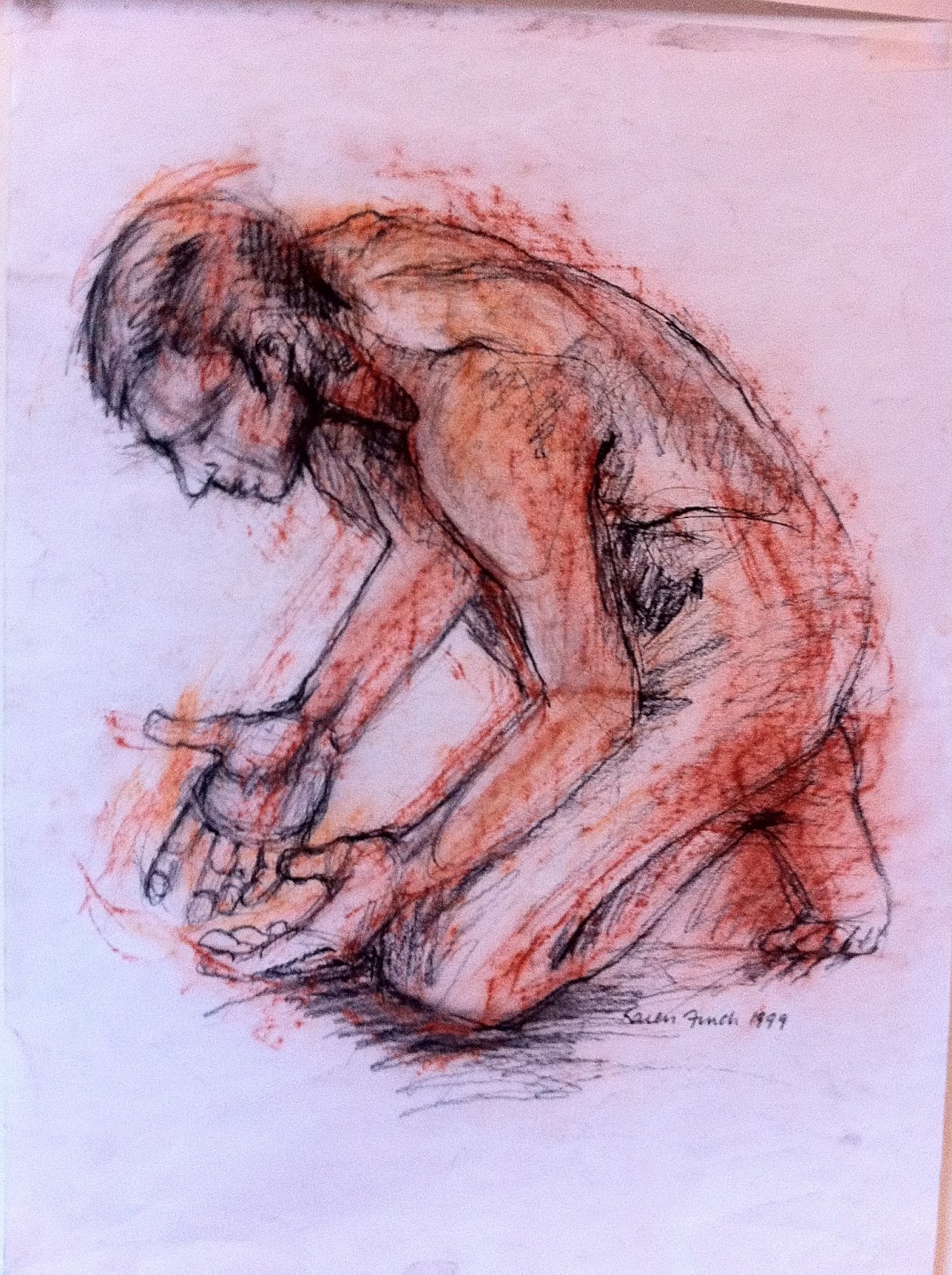
Supplication. Mixed media on paper
*Rheumatoid arthritis. A systemic, autoimmune disease, which initially affects joints, but can also involve major organs. It is painful, degenerative, and there is no cure.

Monday, 22 February 2016

When kids make up words

I saw a Facebook post today by Smaggle about a small boy who created 'bin-oco-lookers', that reminded me of one of the things my children - as many do - did that has lasted into current time. They both made up words, and the best of them - and sadly, while there were many more, I never wrote them down, so they've been lost - are part of the family vocab to this day.

How to, as parents and the adults mostly around them, conduct ourselves with small children is something that is still debated as far as the baby talk vs no baby talk argument goes. Both the boys were bright and advanced with language, and had impressive vocabularies as small children. As a young man, No.2 was a formidable Scrabble opponent too! They were both read to from the beginning, and I wasn't one for baby talk, so conversations - from birth - were regular ones. No.1 had a tendency to contract words, while No.2 tended more to enlarge them. But it was the variant creations that we loved, and to this day, there are a few gems that we all still use.

Stagon wayshun - station wagon. Pretty self explanatory, really.
Windscreamers - windscreen wipers. A personal favourite.
Ambience - ambulance. He could say it, but liked his version better!
Hoppycopter - helicopter. Particularly brilliant, I think!
Vegables - vegetables.
Fi-shen truck - fire engine.


They both delighted in nonsense poetry like Lewis Carroll's Jabberwocky. No.1, who'd been bilingual as a tiny child (I was learning Italian at the same time he was learning to talk, so the end result was that he switched between languages fairly randomly!) loved mixing up Italian and English words. It was quite deliberate, as he knew the difference...but the confounded expressions on people's faces were clearly irresistible!

We used to play a game with a dictionary - which you can buy now as the board game, Balderdash - taking turns to pick out a word and have everyone else make up definitions for it. It's a game that can be played with a mixed age group, which was useful with two six and a half years apart. 

Now and again, we'd hit some sanctimonious type who couldn't help themselves, and HAD to correct. As I said to both of them - as my mother had said to me - language is a living thing. It changes via usage, and experimenting with it didn't make what they were doing wrong. Obviously, there's a time and a place for mucking around with it, but the joy they had with their invented words and the reactions of family was worth more than treading on them and forcing corrections that weren't really all that important, given the context. 

After all, Dr Zeuss made a career of nonsense words, did he not?!

Friday, 12 February 2016

Lockout laws - an antidote to Australia's culture of drinking and violence?

Sydney's current lockout laws - which specifically target the King's Cross area and the CBD (apart from the Sky City Casino and Barangaroo precincts) - are under fire, primarily from clubs and other entertainment venues, due to lost revenue. They were brought into place after a series of incidents of alcohol fueled violence resulted in the deaths of young men from so called 'coward punches'. 
Since those laws came into being, violence in the Cross and the CBD is down. However, as posts on social media and articles in local press indicate, some of the violence has moved to areas where there are no lockout laws - specifically, the inner west suburb of Newtown - prompting the question as to the usefulness of the laws in the first place. If all imposing earlier closing hours does is move people onto another area where there aren't early closings, do the lockout laws work?

Sydney nurse, Paul Harwood, who works in intensive care at St Vincent's Hospital, Darlinghurst (near the Cross), and whose wife is an ER nurse, posted THIS VIDEO on Facebook this week. In it, he makes it very clear that in the time since the lockout laws were enacted, the number of cases he's nursed that are a result of alcohol fueled violence have lessened dramatically, and the degree of violent incidents in the ER have also lessened. Professor Gordian Fulde, Senior Australian of the Year for 2016, is a staunch supporter for the lockout laws. As head of St Vincent's ER, he described, in an article in the Sydney Morning Herald, his department before the lockout laws as a "war zone" and the decrease in severe head injuries since then as "spectacular and terrific". 

Whether or not the lockout laws are directly responsible for the drop in violence or not - and there are reports that argue otherwise - the fact remains that, as a society, Australia has a serious problem with both alcohol and violence. I wrote recently about the ongoing incidents perpetrated by NRL players during their off times - usually at parties, or out and about at clubs or pubs. These incidents are an ongoing problem, prompting discussions in the press about the underlying drinking culture in football. 

I watched, with no small degree of alarm, as the stepson made his way through high school and a growing social life that was centred on parties organised and advertised via social media. There was a lot of press coverage at the time about teen parties getting out of control and being raided by gatecrashers. He was at parties where this happened. There was also a lot of alcohol at the parties - and a tacit sense that that was both expected and acceptable. At the time, nearly all the legitimate (invited) party goers were well under the legal drinking age. 

I'm no prude. I drank underage - most of us did. At home, for special occasions, we were allowed wine - one glass, and watered down - at a celebratory meal, in much the same way as is common in many European cultures. Parties with school friends could sometimes feature illicit supplies of beer - but not very much, because no one had the funds to spend on it, and the consequences if we'd been caught by our parents would have been pretty severe. By the time my eldest reached teen party age, it was becoming a bit more of an issue, but I kept on top of it and denied permission to attend parties that weren't supervised. Once, and only once, I got the call to go and get him from a party where the drinking had got out of hand. He was a pretty cheap drunk, and hadn't had all that much, but he was well away, talking non-stop, and reeking of beer. The sore head and marked lack of sympathy from me the next day left him a bit to think about! He was a bit of a control freak though - still is - and tended, even when he was of age, to not drink to excess in public situations, where he could lose control, and more importantly, be seen to lose control. There were odd times when he'd gather at home or with mates at one of their homes, and get quietly blotto...which he always seemed to regret afterwards. 

In the case of the stepson though, it started earlier and much harder, with vague talks of 'gatherings' that turned out to be in the scrub bordering suburban beaches with significant quantities of illicit alcohol - and rarely beer. They started with cruisers, and moved on fairly quickly to bottles of spirits, which I found particularly worrisome. 

There were a number of parties where the police had to be called - usually because of havoc wrought by gatecrashers - and not a few brawls. And there was a hospital visit after he consumed a huge amount of vodka far too quickly to be safe. Fortunately, his mates saw sense and called an ambulance. 

The thing is, this isn't uncommon with his age group. We've had numerous conversations with him about the nature of these parties, especially since, after the event, he all to often said how boring they were, and really not any fun. That makes sense, if all they consisted of was a lot of people drinking too much and fighting...that's not fun at all. 

Currently, in the eastern suburbs, there is a gang - one of many - circulating, doing the rounds of pubs in the area, looking for trouble. He knows many of them - some of them were at his school a few years behind him. Their aim appears just to be to head to a pub, do some drinking, and then provoke a fight - and this is happening over and over again. However, it appears that the norm for many of our young people is that drinking is appropriate, and excessive drinking is entree into the 'cool club'. Queensland teen Joshua Blake wrote this article about his experience of the drinking culture of his peers, including the pressure to drink in order to fit in. They're starting early, drinking harder, and by the time they're of age to drink publicly, they're well entrenched in a culture of heavy drinking.

A lot of the social media commentary around the lockout laws is from people speaking out against the troublemakers, saying that not everyone is like that, and asking why laws have to be in place that limit the options for going out for others who aren't violent. It's a good question, but at the same time, I query the need to be out drinking at 3, 4 or 5 in the morning... Is it really necessary, in order to have a good time? Others, responding to this, have volunteered the eminently sensible (well, I think so) suggestion to head home and continue any partying there once the venues close. And seriously, is there anything wrong with that? It eliminates the walk of shame at dawn, heading home in bedraggled evening wear, for starters, not to mention ensuring that everyone is safely in a home environment where they can crash and burn without serious repercussions. 

I am in favour of the lockout laws. I have no issue at all with people heading out to clubs and bars and having a good time out with friends. I do have an issue with those public spaces turning into venues for violence and bloodshed - which is an increased risk, the longer they are open and the more intoxicated people can get in a public space that continues to serve them, regardless of how drunk they might already be. Add recreational drugs to that mix and it's a recipe for mayhem. I don't think it's necessary to be out all night in order to have had a good time, and nor do I think that dropping the amount we drink per session is going to seriously lessen the fun that can be had. Alcohol relaxes people's inhibitions, and allows latent characteristics to come to the fore, and if those latent characteristics are violent, it's a problem. 

While there may be other, more creative solutions, as touted by local politicians and police personnel - explored in this article in today's Sydney Morning Herald - the lockout laws, according to those at the coalface, have already had a significant effect. That they may need to be extended to other areas to enlarge that effect is a simple indication of the depth of the issue, and an indicator that there is more work to be done. Some of the solutions used overseas may be useful to implement at some point, but they won't deal with the underlying issues of alcohol abuse and violence in Australian culture. As Joshua Blake wrote in his article,
However, significant improvements can be made if Australia changes its drinking culture ... To make this change, Australians need to drop this sense that heavy drinking is a part of our identity. Admittedly Australia is not the only country with heavy drinking inherent in its national identity, but by that count, we are not the only country with a problem and one evil does not beget another.
Fixing the problem is not easy. The first step, however, is to admit there is a problem.
We DO have a problem - as a culture. And it's past time to admit it.