Wednesday, 18 February 2015

Balanced parenting: #1 Get enough sleep!

OK, this is the beginning of a series that are a spin off from my last post, expanding on parenting strategies that I did to try and survive mostly sole parenting, while studying, working and managing a chronic illness. It was all aimed at keeping my nose above the surface, rather than getting totally overwhelmed. Sometimes, it even worked - when everything came together at the same time!

Ask yourself what's the first thing that you don't do when you're over-stressed, have way too much on your plate, and you feel like you're constantly behind the eight ball? I'd put money on you answering that you're exhausted all the time and you're just not getting enough sleep. However tempting it might be, once the kids are all tucked in, to take advantage of some rare peace and quiet and keep going, trying to catch up on everything, in truth, it's possibly the worst option you could choose.

There. How inviting is that? Allowing for differing tastes in decor, of course - and, by the way, it's not my bedroom, although I do like it enormously, perhaps minus that huge mirror! First priority is to make sure your bedroom is a sanctuary, and it's just a place to sleep. Invest in a really good quality bed. You spend a lot of time in it, it has to be good. Also, buy good quality linen - I have a set of Morgan and Finch sheets that are such fine cotton they're like silk - we LOVE those sheets, and I swear I sleep better in those than any of the others we have. Also, look at your quilts or blankets - most of us try and sleep too warm. I often try and use heated wheat packs when I have particularly sore joints, and I find I get too hot. My partner also sleeps with more bedclothes than me, and when I'm hot, my sleep is very restless.

Every article I've ever read about 'sleep hygiene' says that one of the most important things to ensure that you get good regular sleep is to keep your bedroom for sleeping - and sex, if that's also on your agenda! Don't take your work to bed - EVER. All those shots of couples in TV shows sitting up in bed with their work glasses on, balancing files on their knees - do.not.do.that. EVER. If you do yoga, or other exercise at home, don't do it in your bedroom.

Banish your devices to another room. That means everything - from your phone, to TVs, computers, iPods, and even digital clocks (as an aside, apparently couples with TVs in their bedrooms have, on average, half as much sex as those without...worth a thought...). Again, everything I read about sleep hygiene points to clearing your room of all electronics. The light emitted (e-readers, phones, digital clocks) can interfere with your body's sense of the light, which messes with your circadian rhythms, which then impairs your ability to sleep soundly. If you need an alarm, invest in an old-style alarm clock that doesn't tick.

Get some regular exercise. OK, you're already over-extended...how are you going to fit that in too? If your kids are school age, look at walking them to school - that's good for them and you. Try and aim for one school run being on foot. Alternatively, negotiate with your partner for early morning sessions before everyone else is awake - starting the day with a walk, run or a swim can kick start your energy levels wonderfully. If you're trying to manage this stuff with a chronic illness, you might need to work around what your body will allow - maybe work on an early evening exercise session, before you have dinner. You only need half an hour at a time - and it can make an incredible difference to your sleeping patterns.

Stick to a routine. You CAN train yourself to sleep more regular hours - but it might take some time. First up, train the kids - set bedtimes and stick to them. We have neighbours with little kids. I hear them at all hours of the day and late into the evening crying and fussing. It's rare that they're bedded down and quiet at what I would consider a reasonable time - they certainly shouldn't be roaring around at 10pm or later every night... It stands to reason that if you don't have your kids in bed at a reasonable time, you're not going to have a hope in hell of getting there yourself. While they were in primary school, my boys were in bed by 7-7.30. Towards the end of primary school, that got extended to about 8.30 - IF they were quietly occupied in something peaceful, but usually not TV at that stage. That was early enough in the evening for me to get some quiet time to myself before heading to bed - which, particularly in my sole parent periods, was absolutely vital. Try and aim for regular bed times and getting up times for everyone. Apart from anything else, it lessens the arguments. Bed time is bed time!

Go easy on food at the end of the day. In amongst the various good reasons to follow the old adage, 'breakfast like a king, lunch like a lord, dinner like a pauper', is the effect a heavy meal at dinner time can have on your sleep. If your body is busy trying to digest a big meal, it won't be ready to start switching off to go into sleep mode. The same goes for drinking in excess. Lying in a spinning bed is NOT conducive to nodding off gently! Also, and this is a no-brainer really, watch the coffee intake late in the day... Caffeine isn't going to help you sleep!

Find activities that help calm and settle you before you try to go to bed. I read - just ask my partner... He's a bit of a fruit bat (doesn't like lots of light) so he's taken to using an eye mask of late (and he's usually snoring within about ten minutes!) so I can tuck myself in with my book - because I find it takes me longer to drop off if I just get into bed and turn off the light there and then. If I tuck myself in and read for a little while, I have a much better chance of dropping off quickly. This is a good one to start with the kids too. I read to my kids most nights - starting with picture books and slowly working up to chapter books that we read over a period of time. Sometimes they piled in together on one of the beds - usually on No.2's so he could be tucked in and left to sleep once the story was done. It's a good habit to get into as a way to wind down. You're also modelling good habits for your kids with stuff like this, and that can be one of the most effective parenting methods of all - you asking the same of them as you're doing yourself...it deprives them of the opportunity to do the "it's not FAIR" thing...!

For those of you with under school age kids, the broken night is part of your 'normal', right? It was definitely part of mine with No.2. He didn't sleep through until late kindy age. That's when I learned to nap during the day - something I only do if I'm exhausted or really sick. When they were growing up, finding me asleep during the day used to panic both of them because it was so abnormal for me, they figured something was wrong... However, as much as you can if you have a nocturnal child, sleep when they sleep during the day to catch up. And at night, don't make it attractive to be awake. Night time feeds, changes and getting back to sleep stuff were always quiet; no talking, no games, nothing to stay awake for...

Finally, a word about medications. I take a ridiculous number of drugs to manage my RA. Some people I know take even more than me. It can feel quite ridiculous. It's really important to understand how the drugs work, and which ones NOT to take at night. At the moment, I'm taking prednisone, in the wake of a huge flare up last year that we couldn't get under control. I'm slowly weaning off it, but it'll still be a few months before I'm completely clear of it. One of the less fabulous things about prednisone (one of the MANY less good things...) is that it can rev you up - so NOT to take it at night. Some meds might even help with sleep - another of mine appears to be doing that, although it can leave me quite foggy in the mornings, so that's a bit of a bummer!

Monday, 16 February 2015

When you're NOT having a good day

One of the things about becoming a parent that doesn't become truly real until you're in it is the unrelenting nature of the job. It just DOESN'T stop. Ever. My boys are twenty three and twenty nine now, and the stepson is nineteen. None of them are ever far from my thoughts, particularly my No.2 - I've still had no contact with him, so I still don't know where and how he's living, if he's working or spiralling further into addiction. I was diagnosed with Rheumatoid Arthritis about eighteen months after No.2 was born, so that added a whole other layer to the demands of parenting. You can read more about that HERE.

By and large, my partner and I are now living a child free life, with all three mostly not with us. The stepson has worked all summer in a job near his mother's, so he's been living there. He goes back to uni this week, so I'm expecting to see him at some point, and at the back of my head is the thought that I need to be prepared for the fact that he'll arrive without notice (which is his usual tendency) and whatever was planned for dinner will be something he doesn't like, or there won't be enough, and there'll be a last minute turmoil around catering for him. I figure I'll hand that over to my partner if - when - it happens, because I'm really not very well at the moment again.


I have a friend who is also chronically ill with aggressive disease, who has two young teenagers, is on her own, and is just starting a certificate course that could contribute to her being able to rebuild a career. Her struggle has reminded me of strategies I used when my kids were at home and I was studying and working, while trying to balance my health needs, so I thought it would be interesting to put those together in a post and invite readers to contribute some of their time and energy saving strategies for managing busy lives, and especially those intended to make the more difficult times possible.

Getting enough sleep

While this sounds incredibly obvious, it's often the last thing we consider when we're overwhelmed. The need to get everything done can get in the way of prioritising sleep. Sleep deprivation can very quickly exacerbate that sense of being overwhelmed as the fatigue builds up, stress levels rise, decision making abilities are impaired, and our capacity for patience disappears. Getting enough sleep isn't a luxury, it's an absolute necessity. Staying up late to get that last job finished doesn't work long term - the job will be there in the morning... Plan a regular bed time, and set an alarm to get up at the same time and try to train your body into a sleep routine.

Eating well

We all do it - grab a snack instead of taking time to sit down and eat properly when we're tired, rushed and/or feeling ill. Again, it makes no sense in the long run because the impact becomes cumulative. Eventually, we get incredibly run down and the wheels can fall off completely. Also, we lose valuable sitting down time with our families - and these are the times when we can keep in touch with where everyone in the family is at. 

Give the kids responsibilities

I know SO many families where the parent/s is/are running themselves ragged, and a huge proportion of what they're trying to manage could be spread around the whole family, including the kids, no matter what their age. It is never too soon to start giving kids jobs to do - and the earlier you start, the more they'll be into it, because little kids LOVE being given 'grown up' stuff to do. The other benefit of starting early is that it becomes just 'normal' for them to be part of the family workforce. If you leave it until you think they're 'old enough' for responsibilities, you run the risk of coming hard up against them rebelling when they find their time and efforts being required instead of being at their own disposal.

Find support

Whether you're sick or healthy, parenting is damned hard work. It is relentless. Some days will be easier than others, but it doesn't stop. The saying, 'it takes a village to raise a child' harks back to pre-nuclear family times when people still lived in an extended family network and had closer relationships with neighbours and others in their immediate vicinity. The rise of the nuclear family has resulted in parents trying to manage in previously unheard of isolation, and the sense that to ask for help somehow means that we're failing. If you don't have family close, find people with whom you can share the load. Team up with other families with kids so you can take turns to give each other time out, and show the kids that all the stuff you are working through happens in families everywhere - the good and the bad.

Take time out

Be better to yourself. You're important too. Obviously, the kids are a number one priority, but there's a definite case for not putting them first EVERY time. If you don't look after yourself, you won't be in any fit state to look after them. Make time for yourself without them so you can recharge your batteries. You'll feel better for it, and they'll benefit too. It may mean making a regular day or evening where you take a couple of hours off and leave them with a babysitter so you can go see a movie or take a walk by yourself. It could mean enrolling in some study you've been wanting to do. For couples, it could - and possibly should - mean a regular date night so you can keep your relationship on track without the usual distractions of the kids. For the kids, seeing that you're looking after yourself is an important message too - it shows them that you need to be valued too...

I will enlarge on all these areas in subsequent posts. This is just to kick it off, and I'd welcome any suggestions for things to add, or things that you, my readers, do to manage your busy lives. Please don't be shy - it would be very useful to hear your ideas, and if you have friends who might like to get involved, please point them in the direction of the blog.

Links to the rest of the series - I'll update as I write them.

http://theoriginaldragonmother.blogspot.com.au/2015/02/balanced-parenting-1-get-enough-sleep.html


http://theoriginaldragonmother.blogspot.com.au/2015/03/balanced-parenting-2-eating-well.html 

Sunday, 8 February 2015

Taking Stock

I follow a number of other blogs, for all sorts of reasons. One of my favourites is WoogsWorld - Mrs Woog is great fun, blogging every day on all things relating to life, the world and everything. She just posted with this list, that she'd 'borrowed' from another blog, so I figured, why not...? So I've copied and pasted, and here are my answers to what's going on in my life at the moment. You can go look at hers HERE.

Making: A list of what I need to do today.

Cooking: Lots of vegetables daily, because if I do enough clever things with them, it drops the semi-automatic massive meat consumption in this house! 

Drinking: Tea.

Reading: Mr Shakespeare's Bastard, by Richard B. Wright (which I discovered in the pile of books waiting to be re-shelved, and I hadn't even read it yet! Bonus!!).

Wanting: A holiday!
Looking: At the travel pages of the weekend pages...

Playing: With the kitten...because how can you not play with a kitten?
Wasting: Too much time too often (playing with the kitten...)!

Sewing: Note to self...it's WAY too long since the machine was out. There's enough fabric in the stash to fill the gaps in the wardrobe! 

Wishing: I was three people - so much to do so little time. Although, the times I've wished that out loud, my nearest and dearest have looked a wee bit hunted...

Enjoying: That I've had ten minutes without a request from Himself for tech assistance with his Powerpoint presentation.

Waiting: For Himself to ask for assistance making his Powerpoint presentation for the umpteenth time! (Cos what I'm doing is apparently completely recreational...).

Liking: That there's a cool breeze coming through the back door and I'm right in its path.

Wondering: If my plan to build up this blog to create a better writing profile for myself will be as successful as I want it to be...

Loving: That I keep meeting the most amazing people quite unexpectedly.

Hoping: That my RA flare is well and truly over, and I can look forward to more improvement from the new biologic drug - AND that the prescription from medicare arrives soon so I can fill it before I run out completely!

Marvelling: At the resilience of the people I know who are dealing with chronic illness and still manage rich and productive lives.

Needing: COFFEE!

Smelling: Rain in the breeze - which won't please most Sydneysiders if it comes, but the hell with that, we NEED rain!

Wearing: Orange tank top and hand painted sarong that was my mother's. So, I really need to put proper clothes on so I can be presentable enough to wander down to my local for COFFEE.

Following: Mrs Woog, Styling You, Bianca Bigwords, a gazillion different book blogs - not just for the fun of it, but to take notes and learn from the gurus... 

Noticing: I really do need to clear the kitchen benches before too much more time has passed.

Knowing: If I don't clear the benches, it will irritate the hell out of me to keep walking through the kitchen!

Thinking: It's probably time to sit down and write a master plan for the projects that are happening this year so they actually do happen... 

Feeling: Like writing a master plan is like writing a business plan. I hate writing business plans!

Bookmarking: Recipes for inspiration for one of said projects...watch this space!

Opening: Emails with work assignments that are falling short of what I need at the moment.

Giggling: Over the utter futility of worrying too much about things I can't change - cos if I don't laugh, I'll cry...

Feeling: Like there is a lot ahead that could mean a hell of a lot of change, and I'm trying to feel excited about it, rather than overwhelmed.

Well... I did it! That's a long list, and needed a bit more thought than I'd anticipated. Interesting though. So, have a go!! Go on...you KNOW you want to. Drop your list in the comments, or hop across to Facebook - did you know Dragon Mother is on Facebook now??? You can find me HERE - and drop your list in the comments there.

Sunday, 1 February 2015

The Theory of Everything - and achieving stuff

My partner and I went to see The Theory of Everything yesterday. We'd seen the trailers and read some of the reviews already, but even so, were quite unprepared (both of us) for the impact of the film. 
Felicity Jones and Eddie Redmayne with Stephen Hawking
I didn't know much about Stephen Hawking, to be honest. I'll have to do some reading now. In a way, going into the movie with little background knowledge possibly wasn't a bad thing. I was very ready to be 'told' the story. Above all, the strongest impression I was left with wasn't so much the man's brilliance, as his strength of character and utter refusal to give up, in the face of the seemingly impossible challenge of a disease that was going to rob him of everything but his mind. 

The early scenes as he's struggling with losing coordination, before he's diagnosed, had me wiping tears away - I SO remember that stage with RA. Realising that something is happening, but not knowing what it is. Keeping on with normal life despite the changes, because that's what you do. Then the point - in Hawking's case in the film, following a crashing fall in the quadrangle at Cambridge - where it's taken out of your hands when the doctors enter and the investigation starts... I'd like to make a clear disclaimer before I write any more - I'm not, in any way, trying to medically equate RA with Motor Neuron Disease. They're very different diseases. What I can identify with, however, is the loss of 'normal' function and the confronting reality of having to face a life that is going to be very different to the one ahead of someone in good health. 

For me, this movie is a story of triumph over circumstances, and one that holds a valuable lesson for everyone. We ALL have 'stuff'. It might be illness and/or disability. It might be family issues. It might be learning difficulties. It could be ANYTHING. The notion of a 'perfect' life is a myth! If we can accept that, we can put ourselves onto a much more constructive approach to dealing with life as it comes to us.

My own experience of being diagnosed with a chronic, degenerative disease was accompanied by lots of well meaning, but totally misguided, advice to slow down, stop doing a lot of the things I was currently doing (and loving), rest more, give up stuff, and so on. I was twenty eight, had just gone back to work as a chef, was singing in the chorus of an opera company part time, had a six year old at school and a nursing seven month old baby when things started to change. It was another year before I had a diagnosis. That was twenty three years ago, and I STILL get people telling me what I can and can't do - "because or your arthritis". 

One of two things happens when you tell someone they can't, or shouldn't do something. Either they cave, or - like me - they get bloody minded and do it anyway to prove that they can! Either of those responses can come from their innate personality, or it's something they've learned to do due to circumstance. Among other things, I'm an artist, so I'll use the following analogy simply because it's something that comes up regularly in conversations I have with all sorts of people. How many people do you know who say they can't draw? Now, take a room full of preschoolers, give them paper, crayons or paint, and what happens - they draw and paint without any thought about can or can't - it's just about the pure joy of making marks on the paper, and the results are wonderfully spontaneous and creative. Take that same group into school, and how many years is it before you start hearing "I can't" - and WHY? 

I watched this with my boys, both of whom have considerable ability with a pencil and other creative endeavours. Over the years, as I fought their teachers on this matter, I realised that so much of what got in the way of them continuing to have the joy in the drawing process, and therefore, the desire to keep doing it and exploring their creativity, was that they were told that what they drew was 'good' or 'bad', 'right' or 'wrong' - and those judgements affected their perception of their own ability. My younger No.2 is very much an innately bloody-minded type, so it had less effect on him overall. No.1, however, had to be carefully nurtured through that, and I fought many more battles on his behalf, right into high school, until he finally dropped art to fit in the subjects he needed for Year Twelve. 

The point of the analogy, of course, is that when we pass judgement on people's ability to achieve things, we do more than just say the words. We can be, with the best of intentions sometimes, seriously undermining their confidence in their own sense of what they can and can't achieve. There are a gazillion memes that float around on social media sites that allude to the idea that the only thing that blocks us from achieving things is ourselves. Unfortunately for children, that's something they have to learn, and sadly, it's something many people don't start to even begin to understand for themselves until their childhood conditioning has well and truly bedded in and blocked them from all sorts of potential. 

There were all sorts of things I envisaged myself doing, as a child, and most of them I didn't do - voicing them brought down, all too often, responses of "don't be ridiculous" - because I was a girl, or because we lived in the country, or because they were outside my parent's areas of understanding or interest. I lost interest because I came to feel that those things were unattainable. When it started to happen to my children, I regained my voice on their behalf.

In his early teens, No.1 joined the RAAF cadets, and within a couple of years was seriously considering heading into the air force once he'd finished school. His father's response to that was to start bombarding him with all sorts of awful statistics about life expectancy for fighter pilots (he wanted to be top gun, of course!), and other hugely negative aspects of being in the defence force. He came to me asking what I thought. I took a moment and gave him two answers. One, that as his mother, I was horrified by the idea because there is NO parent on the face of the planet that wants to see their child going into a profession that, by its very nature, puts their lives at risk. He took that on the chin, and asked what the other answer was. I told him it was his life and his choice, and if he chose to do that, I'd back him all the way, because I had no right to stop him making his own career choice, regardless of how I might feel about it. As it happens, he didn't join the RAAF. But, one of his mates did, and I believe he took some of that conversation to his mate's mother when she had a huge melt down about it.


The bottom line is, and this is what's been running around my head since the movie, no matter what life throws at us, we are only limited by the blocks we make for ourselves. It's probably the single most valuable lesson we can start teaching our children from the very beginning - encouraging them to have a go, even if we, from our perspective, might consider that they may not succeed. Ultimately, that's for them to discover - and then find another way to tackle it! 

Monday, 26 January 2015

Guns and toys


I bought the current issue of Australian Marie Claire with my shopping this week - it's one of my guilty pleasures. I like the reportage - and the fashion and food sections! In amongst the articles is part of a photographic essay by Belgian photographer An-Sofie Kesteleyn that was inspired by the story of five year old Kristian Sparks, who shot his two year old sister, Caroline. It wasn't like so many of the stories you hear about kids playing with their parent's weapons and discharging them. It was with a gun that is being marketed in the US as a child's 'first gun' - and comes in pink and blue, just like baby clothes.

To be fair, clearly Kristian's parents didn't intend for him to be shooting people when they gave him the gun for his birthday. However, what is a common practice in many places in the States, where hunting and gun ownership are the norm, clearly creates an environment where accidents of this type are almost certainly going to be much more frequent. Within this sector of the community, teaching a child to handle a gun early is 'normal'. From my own perspective, thinking back to when I was five, that was the age my godmother took us all to learn to milk the house cow! With my own children, I think they were at a stage where, perched on a chair, they were learning to do most of a load of washing up by themselves. 

American gun culture is pretty alien to me, I have to say. I get the historical context from within their constitution - the statement about the 'right to bear arms' which dates from times when the country was in its infancy. However, given that it's in the constitution, it's become something that smacks - to me - of a sense of entitlement to, at times, take the law into one's own hands. And certainly, it means that gun ownership is something that isn't restricted to those on the land, or in gun clubs for sport, as we find more commonly here in Australia. The Port Arthur shooting prompted then Prime Minister John Howard to initiate a review of national firearms laws, and there was a huge buy back initiative of restricted weapons.

Accurate statistics are not available for the number of people killed by children accidentally shooting them. Off the top of my head, apart from the Kristian Sparks case, two other cases come to mind from recent times - one, a toddler who shot his mother in a supermarket with the pistol she carried in her handbag, and two, the nine year old girl who killed her instructor with an Uzi at a shooting range. 

In the first case, the woman apparently always carried a pistol, because she comes from a family who love to hunt and all own weapons. The pistol was in a specially designed pocket in her handbag, specifically for carrying a concealed weapon, given to her by her husband. She was in Walmart with the toddler in the trolley, and four nieces on foot with her. A moment of distraction, a curious toddler rooting around in her bag, a gun with the safety, obviously, not on...and now she's dead. In the second case, the nine year old girl was being instructed in the use of an Uzi - a high powered automatic weapon used by the armed forces. You have to ask WHY??? Why on earth is a nine year old being taught to shoot in the first place, and with a weapon like that? By all accounts, the kick back from those is hard for an adult to manage, let alone a child. It makes no sense at all. 

What Kesteleyn's photo essay really hammers home is the 'normality' of guns in American culture. While events like the Sandy Hook massacre have galvinised more people to protest for changes to the gun laws in America, the gun lobby appears to be an extraordinarily powerful force, and nothing much seems to be changing.
Cross to Sydney, and the recent siege at the Lindt Cafe with the loss of two innocent lives. In the wake of that event, independent senator, David Leyonhjelm wrote an article for the Sydney Morning Herald claiming that if Australians were permitted to carry weapons, there'd have not been the tragic outcome of that siege, as hostages would have been able to defend themselves. Leyonhjelm's party platform includes a mandate to be able to own and carry weapons, among other things. However, from the backlash against the article, it would appear, thankfully, that the majority of Australians don't agree with him.

I find myself, each time I hear of a new gun tragedy in America, being deeply thankful I don't live there. That similar incidents are much rarer here. And that's how I'd like to see them stay. I don't want to see our society reach a point where they're complacent about guns, because it's 'normal' to have them. I grew up partly in the country, so I knew people who had them who lived on properties. They weren't complacent. Those guns were locked up with the ammunition in separate locked cabinets whenever they weren't in use. And certainly, as little kids, they didn't have access to them, ever. One of my mates got given his first gun, a twenty two, for his 16th birthday. That was pretty standard. And again, there was a context. They were on properties, having to deal with feral foxes, rabbits and other pests, as well as having the capacity for putting down stock that got injured or was sick. So, it was part and parcel of the business of farming. I can see the attraction of sport shooting too - clay pigeons, and range shooting. I did archery for a little while before my shoulders gave out, and loved the mental challenge of the focus needed to hit the target. Since I can't do archery any more, I've toyed with the idea of a pistol for the same challenge - but I don't really want to shoot a gun. And in any case - again, it's not about hunting, or wanting to have a gun to have a gun...

My instinctive reaction, always, when I read about these shootings is that guns aren't toys. I got into fearful trouble with No.2's father's family when I refused to allow them to give the boys toy guns. The very idea of making toy versions of them dilutes the concept that they're NOT toys. They're dangerous weapons that are designed to kill things. It didn't stop the boys playing shooting games - like my brother, friends, and I as children, they made them out of sticks and Lego. There was a clear element of make believe involved. Offer them replica guns and that fantasy element is hugely diminished. With the kids in America, they don't even have that element of fantasy - they're being given real guns. They're growing up with this as 'normal'. There is nowhere in my thinking that I can find that that's OK.

*Images from An-Sofie Kesteleyn's photographic essay, with the drawings she asked each child to do to tell her what really frightened them. For me, the absence of fearful things that could be dealt with by shooting is particularly telling.

Sunday, 18 January 2015

The death penalty - who is responsible?

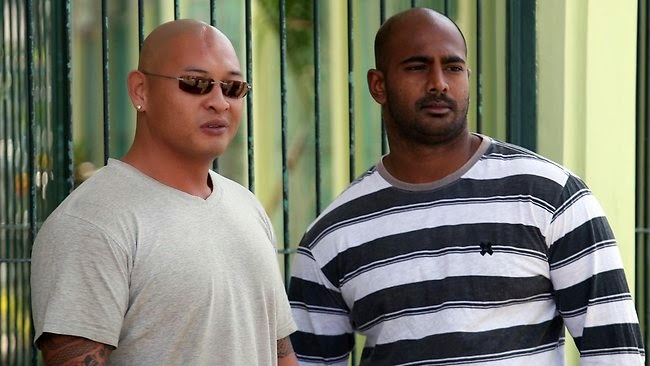
After six people, five of them not Indonesian nationals, were executed yesterday in Indonesia for drug trafficking, there have been renewed calls on the Australian government to intercede for Australians Myuran Sukumaran and Andrew Chan, who after their appeals have failed, face death by firing squad sometime this year. Foreign Minister, Julie Bishop, appeared on breakfast television this morning, stating that she and others continue to 'make representations' to the Indonesian government, and the press is full of articles that voice Australian outrage about the death penalty.
Andrew Chan and Myruan Sukumaran
Those executed yesterday included a Brazilian and Dutch national, and the ambassadors from both countries have been recalled home in protest, after pleas from their respective governments failed to sway the decision. Bishop was asked if, in the event that Sukumaran and Chan are executed, whether Australia would recall its ambassador too. She fudged the answer on that, but as my partner queried at the time, Indonesia is one of our strongest trading partners, and we have a ticklish relationship with them at the best of times, so will the government risk that for two individuals who made a bad choice?

Personally, I am against the death penalty. I don't honestly believe that killing someone solves the issues surrounding this particular crime, or indeed, many other crimes. The Hoopla ran a story today asking how executing people can stop drug trafficking. The evidence, with people continuing to traffic drugs, even to countries with severe penalties like Indonesia, would suggest that the lure of 'easy' money is stronger than the potential deterrent of a death penalty, should you be caught.

At the same time, I have to feel that people who continue to smuggle drugs in and out of Indonesia have to be incredibly arrogant or completely stupid - it's not as if we in Australia are unaware of the stiff penalties those who are caught could face. And despite the many articles and news stories that speak of Chan and Sukumaran's rehabilitation during the time they've been incarcerated, I find myself wondering how much of that has been due to having had a death sentence hanging over them for the years since they were arrested. Clearly, at that point in time, their focus was on moving the drugs and making their money - and there was, perhaps, little thought about the havoc those drugs would potentially wreak on many many people and their families. 

I wrote recently about my younger son and his recent very bad choices that have lead him to become addicted to ice. It's now two months since that hurried trip to his home town, and I have no real news of him. A couple of weeks after I returned home, I had an email from the mental health nurse with whom I'd been corresponding to say she'd managed to speak to him briefly, and that he sounded OK, said he had somewhere to stay, and that, no he didn't want to work with them. Last week, I had a call from his psychiatrist's receptionist, as he'd missed a number of scheduled appointments, and they'd not been able to contact him. All I could do was pass on his current phone number and hope he still has that phone. The text message I sent a few weeks ago disappeared into a black hole. 

I deplore the choices he's made. I am so frustrated and angry, on top of being worried sick, by what looks to me like a giant cop out. He told me when I saw him that the ice made him feel like he could cope - which is all well and good until he takes some from a bad batch, or ODs... I have NO good feelings about the people dealing this appalling drug, and would want to see them punished to the fullest possible extent of the law if they could be caught. Here, that wouldn't mean they face a death penalty - just a very long time in prison. And I don't believe that in itself is sufficient deterrent either, because it's clearly not deterring people when the number of ice addicts (not to mention other drugs) is growing, and the median age of addicts is getting much lower. 

I feel so bad for the parents and family of the two men in Bali - who, through their son's bad choices face losing them, just as I face the possibility that I may lose No.2. We're not meant to bury our children. 

However, and what prompted me finally to write this post, this is - at rock bottom - about choices. As I said to No.2 - like a broken record, because I've been saying this to both the boys forever - there is ALWAYS a choice. We may not always like the options we're looking at at any given point in time, but there always is a choice... Those boys in Bali didn't have to traffic drugs. They could have done what many others do, and looked at career options long term. As it is, they've both been studying while they've been incarcerated, and are close to finishing university courses. Why didn't they do that earlier? Sure, it's not the way to 'easy' money, but it's not going to get them killed either. As a parent, I'm sure I know which way I'd rather see my children make that choice. No.2 spoke many times over the last year about the study options he was considering, once he'd found a job and got his routine back on track. I did many things to help him towards that, but in the end, apparently it was all too hard. 

Along with the choices we make comes the responsibility for the consequences. Like it or not, those two things are irrevocably linked. I remember, way back when the boys were tiny, teaching them about consequences. Simple things; if you don't put your toys away, I'll put them away and they won't be there when you want them next. Your toys are your responsibility. It worked. After suffering through the loss of their toys, they learned to tidy up after themselves when they'd been playing. Teaching children is an incremental process of things just like that - the bigger they get, the more important the choices, and the bigger the stakes when it comes to consequences. It may sound like I'm over simplifying this, but honestly, WHAT were the Bali Nine thinking when they made the choice that they did? They knew the possible consequences. They had to know that they were taking appalling risks. Even if they'd slipped through and not been caught, what about the flow on from their actions for countless numbers of others? And ultimately, had they not been caught that time, if they'd continued, eventually their luck would have run out... Is it a symptom of the times we live in that people don't think through their actions? And then, when it all falls apart, that someone should rescue them - because by our lights, the consequences are unfair? 

Indonesia has had the death penalty for serious drug trafficking for some time. When we leave Australia and travel to other countries, we are bound by the laws of those countries when we're there, just as visitors here are bound by Australian law. Surely THAT'S the message that should be getting through. Surely people should be looking at this particular case and realising that there are no easy outs. And, if it comes to these two young men being executed, it won't be because our government failed to sway the Indonesian government. It will be because these two men decided to traffic illicit drugs in a country where they knew that if they were caught, they could die as a consequence. And they did it anyway.

Wednesday, 7 January 2015

The Vaccination Myth

Every time I think the discussion about vaccinating children has fizzled out, it rears its head again. Dragon Dad and I just got back from a walk to our local for morning coffee and the papers. While we were out I read this article by Elizabeth Farrelly in the Sydney Morning Herald about the current situation where we have American anti-vaccination advocate, Dr Sherri Tenpenny, booked to come to Australia on a speaking tour. There has been a vocal response from many in the pro-vaccination sector demanding she be blocked from entry to the country, with a counterpoint saying that Australia's right to free speech says that she should be allowed to come and those who don't want to hear what she says just don't have to go.

Farrelly's discussion revolves not so much about the pros or cons of vaccination, per se, as much as who we, as members of the public, should be able to trust when it comes to the available information about the issue. Well-known medical journal, the Lancet, published a paper in 1998 by Dr Andrew Wakefield that started the MMR-Autism scare and subsequent furore, prompting significant numbers of parents to not vaccinate. That myth has since been solidly debunked, Farrelly citing a 2014 study by University of Sydney Associate Professor Guy Eslick which found 'a consistent ... lack of evidence for an association between autism, autism spectrum disorders and childhood vaccinations', based on a study of 1.25 million children. The Lancet article has since been retracted, with the editors officially saying they 'regret' publication.

The anti-vaccination crew's main argument against childhood vaccinations is mostly based on the potential harm the vaccinations can cause - from allergies to long term serious conditions. As far as I can see, this comes with a (to my way of thinking) willful ignoring of the hazards of NOT vaccinating. As Farrelly says,
But first to the science. There is little doubt that vaccines work, or that anti-vaccination campaigns are largely snake oil.
Take measles. The World Health Organisation announced in March that Australia had eliminated measles, but every year sees a few hundred cases amongst the unvaccinated. 2014 saw outbreaks in every state, with spikes in Queensland, Victoria and WA. Melbourne recorded 56 cases between January and July, the highest since 1999.
Measles doesn't sound serious. Certainly I had it, as a child. Yet one in 20 children with measles will develop pneumonia, says the United States Centre for Disease Prevention, and one in 1000, encephalitis. One or two in a thousand, mostly infants, will die. (Tenpenny, a doctor of osteopathy, puts this figure at three  in ten million).
Or take pertussis (whooping cough). Between 1981 and 2009, rates across the world roughly halved. In Australia, however, they soared – from 170 cases in 1981 to 29,545 in 2009 – prompting Professor  Peter McIntyre, from the National Centre for Immunisation Research and Surveillance, to tag Australia "the world capital of pertussis."
My boys are 29 and 23, so come vaccination time for them, it was still early days in the debate. I do remember some rumblings, but not nearly enough for me to even consider NOT vaccinating them. With No.1, we had a few days of a mild temperature and fussiness, but that was about it, as far as reactions go. He then went on to a disgustingly healthy childhood - the most serious thing we really had to deal with was a particularly nasty case of chicken pox (vaccinating for chicken pox wasn't a thing then) when he was four, and for him, the main tragedy of that was that he couldn't have a birthday party...

No.2 was quite different. At 8 weeks, we trotted off to the local baby centre for the first shot. Within a couple of hours at home, I had a baby spiking a humungous temperature, and projectile vomiting the baby panadol I tried to get into him to bring it down. It ran for ten days, and was terrifying - all the more because I'd experienced a febrile convulsion with No.1, and really didn't want to go there again. All the doctor could suggest was sponging him down and feeding him as much as possible to try and prevent him becoming dehydrated. She also suggested that we do the next vaccination at four months in two parts a week apart. The nurse at the baby centre was a bit iffy about that when we went in, but caved when I told her that I'd leave without any vaccination unless she would do it that way. It didn't work. The temperature was marginally lower after the first dose, but not enough to make much difference, given it too ran for about ten days. Back at the doctor's, she said not to do the other half and suggested it was probably the whooping cough component, and to request the third vaccination minus that bit. THAT was fine. But it meant that No.2 was never properly immunised against whooping cough, and with the rise of cases due to lack of immunisation that was a constant worry during childhood. Fortunately, he was never exposed.

However, at six, after passing a monstrous gallstone, he had to have his gallbladder removed - on the ultrasound, it looked like a bag of marbles. The ultrasound also showed that one kidney was significantly smaller than the other one. The paediatric surgeon said that the formation of gallstones in such a young child could be put down to some abnormality that caused stones that formed during extended febrile episodes to not dissolve once he had rehydrated, and that the kidney indicated that those febrile epsiodes could have been due to undiagnosed kidney infections, but, there were also those extreme and lengthy febrile periods post vaccinations. We'll never really know, and he's healthy now. But, if I had my time over, I'd still vaccinate, because that experience was unusual - which may not be the case for thousands of children if infection and complications due to preventable diseases due to lack of immunisation continue to rise...

I would suggest, for the skeptics among us, that a bit of research into the stats in countries where vaccinations AREN'T done would be sensible, as well as looking at the changes in stats in countries where they are, but people have got on what I consider to be a hysteria wagon generated by irresponsible publications and self-styled alternative experts. Harsh? It's the lives of our children we have to consider, and the wider community. Vaccinations work. Only a small percentage of children will have a legitimate allergic reaction. Even then, the potential consequences of NOT vaccinating can be far worse. 

Please, folks, vaccinate.