Thursday, 29 October 2015

October - taking stock...

Mrs Woog - WHERE would I be without you some days...? I've had a huge list of writing to dos, and top of the list has been paid work, so that had to come first. now I'm left with a backlog of blogging that has to be done. So, to kick start that, I'm taking the 'easy' way out and pinching this idea from Mrs Woog again - I did one of these a while back and found it to be an interesting exercise. Feel free to pinch it from me, and also to drop some of your stuff from the list into the comments - sharing is caring, and all that stuff...you know...!

Making: A new dress for the first time in absolutely forever. It's cut out and ready to go.
Cooking: Lots of different vegetable dishes - tired of salads all the time.
Drinking: Monkey 47 Dry Gin with Fevertree tonic. AWESOME.
Reading: Second Half First, Drusilla Modjeska. Actually, just finished it, now going back and rereading bits. Look for a review on Books Anonymous soon...
Wanting: More new books by Drusilla Modjeska, and to meet her again (bucket list item).
Looking: At my list of things to do - I wish someone could explain to me how lists just keep growing...
Playing: Scrabble on Facebook! So much fun.
Deciding: That I really do need to start de-cluttering instead of just thinking about it.
Wishing: That the de-cluttering fairies would come and do their magic so I don't have to actually DO the de-cluttering!
Enjoying: Writing blog posts where I don’t really have to think to hard, like this one! Thanks Mrs Woog! (Stole this response too...)
Waiting: To move to Melbourne - been waiting for a year now...it's getting old.
Liking: Balmy days with a crisp breeze.
Wondering: How my eldest will go in his first full length triathlon this weekend at Noosa.
Loving: Dragon Dad. Yeah, I know...mushy moment.
Pondering: All sorts of weirdly existential things that I can't put neatly into a line or two.
Considering: Different ways to build Dragon Mother...
Buying: Books.
Watching: The new season of The Good Wife, and enjoying the change of pace.
Hoping: The games will stop and Dragon Dad will be able to move the business forward to the next stage without any more of the turkey cock posturing that's going on...
Marvelling: That the road toll isn't considerably higher, given some of the stupid things I've seen people doing on the road lately.
Cringing: The bright young things with their bottoms hanging out of too short shorts - HOW is that attractive?
Questioning: Why so many people I know seem to be going through such a hard time lately.
Smelling: Freshly mown grass - they must have just done the lawns in the park across the road.
Wearing: Best $100 I've spent in a long time: THIS
Following: SciBabe - new Facebook page that pokes at all the 'woo' out there - the anti vaxxers, paleo nuts, etc... Brilliant - sarcastic satire.
Noticing: How much thinner my hair is getting, and that the grey hairs aren't blending so much into the natural streaks as much as making a definite statement...
Knowing: The hair loss is the bloody disease and accompanying drugs, and I can't stop it.
Thinking: I really need to clear my desk - it's seriously messy.
Admiring: The spirit I see in so many people fighting serious illness.
Sorting: Books - they're all over the house again. I swear they have legs...until it's time to get back to the shelves...
Getting: Very tired of being sick and needing to be MORE inspired by the fighting spirit of other people with chronic disease so I can find my mojo again.
Coveting: More of the range from the boutique at Double Bay I love...
Disliking: Getting in the car after the stepson has driven it and being blasted out through the back window by the volume of the radio!
Opening: The front door which the stepson keeps dead bolting when he comes in late - heaven help that we have a night time emergency!
Giggling: At the antics of my cats - they're good for a few laughs every day!
Feeling: Weary. The disease seems to be changing again and it's wearing. Either that, or the drugs aren't working any more...
Snacking: Grissini - NOM!
Helping: A few people I know who are battling at the moment - at least, I hope I'm helping!
Hearing: Lots of music I used to play in orchestras when I played French Horn - I miss it.
Needing: A HOLIDAY! Seriously - it's been two years since Dragon Dad and I last got away.

I remember, last time I did a post like this, finding it an interesting process, and being surprised how long it actually takes to work through a list like this! I'll be interested to hear from any of my readers if they do one - and what it might look like...

Thursday, 15 October 2015

Growing out of tantrums

Cartoon by Basley

Today, I caught up - on the phone - with an old friend that I've not spoken to in ages. Way too long. She's known my kids since they were small, so there were lots of questions and fillings in about where they're at and what they're doing these days. And also a lot of reminiscing about different stages we went through, the kids and I, and the involvement she had with them - an un-asked for loan helped me get No.1 out of the school where he was unhappy and into the university school for his final year, and that couldn't have happened without her help. 

She made me realise, in the telling, that if anyone asked me for my parenting philosophy - which I'd not really considered in any containable way - I'd have to come down to it being all about logic. This wasn't something calculated. Definitely not something I sat down and thought about before I put it into action. It was something I arrived at by accident, often when I had my back hardest against the wall when they were trying something on and I was desperate. 

Logic takes a lot of the angst out of dealing with tough situations. Allowing for the fact that most kids will keep arguing long after it's sensible when they're trying to prove a point or really want something, it also robs them of fodder for most arguments. 

For instance, No.2 was a hard nut to crack with acting out. Unlike No.1, who's a bit of a control freak, No.2, when his dander was up, really didn't care what anyone thought, so was eminently capable of acting out no matter where we were. The horrors of the public toddler tantrum are all too well known to most parents, and we had more than our fair share of those. I did walk away and leave him writhing and screaming on the floor in supermarkets when he lost the plot - many times. I endured the 'bad mother' glares that were shot at me at point blank range by the holier than thou bystanders too. The reality was, as long as No.2 had me engaged, he was going to keep going - while his vocal cords lasted! Walking away becomes the only defence. There comes a point though, when that all changes. 

I remember the occasion - in yet another supermarket - when he lost the plot over something - what it was, I can't remember... He must have been 9 or 10 by then. I was aware of the looks - hard not to be. But I realised that the condemnation wasn't being directed at me. It was landing fair and square on HIM. I had an epiphany that day, and had the presence of mind to deliver it to him. Speaking VERY quietly - because that's all they hear when they're sounding off and kicking the trolley - I got very close to his face and informed him that if he thought he could shame me into doing what he wanted by chucking a tantrum in the supermarket then he needed to do a very fast rethink. He wasn't getting ANY sympathy from passers by, because I was getting all of that. He was too big for me to be blamed for his bad behaviour at that stage. He was clearly old enough to know much better. Having told him that, I grabbed the trolley and moved on. He was VERY shocked. I remember that. He shut up fast too, and scuttled after me. 

Did it stop the tantrums? Not straight away. He was too much in the habit of them, and too darned stubborn to give them up straight away. But reminding him that he was creating a situation that got ME a lot of sympathy, while he gained nothing, did cut them short and slowly they lessened. It got so that I could shoot him the death stare - Dragon Dad calls it my 'school teacher look' - and he'd swallow down whatever was about to erupt. 

Cause and effect. Consequences. Hit them with logic. It's really hard to argue against clear logic. 

You want a note for the teacher to excuse the homework not having been done? Really? And WHY wasn't it done? Oh, that's right, you decided, despite reminders, that playing cricket with the neighbourhood kids, followed by mucking around in your room instead of just getting it done was a better option. You'll get into trouble without a note? I'm sure you will...how is that MY problem? It's not my problem, it's your problem. YOU didn't do the homework. I didn't do anything to stop you doing it... YOU made that decision. So YOU need to tell the teacher and deal with whatever she decides is an appropriate consequence. That's not fair? HOW is that not fair? YOUR homework, YOUR decision, YOUR consequence. 

Logic. It's a beautiful thing. 

Sunday, 27 September 2015

#RABlog Week: Day 7 RA Blogs I read

It's the last day of the #RABlog Week event. I think I'm going to miss it... It's been something of an effort to post each day - something I rarely do - but at the same time, I've enjoyed digging around where I'm at on different aspects of the day to day aspect of living with RA. It's also been amazing reading posts by other bloggers who are participating. To those of you who have stopped by and read my posts - thank you! Thank you for spending time here. And to those of you who have left comments, thank you so much for your feedback!
This last post is about other RA blogs I have read. Some have stuck in my mind, some I've identified strongly with, some not so much. One thing that's been a stand out for me has been the general tone of positivity in the posts I've read. So much courage, so many people with fantastic attitudes, so much humour, and so little self pity. It's been uplifting and encouraging to feel that, in the face of so many stories of such difficulty and challenges. 

So, particular bloggers...

I've been following Arthritic Chick for some time. The internet was in its infancy when I was first diagnosed, and certainly, there was no social media. When it all changed for me over the last few years, I went online to find resources - particularly about biologics. I found AC's blog and spent a lot of time plowing through it. I love that she's such a fighter, and that she's local, so the information about the medical system was relevant for me. We're now good friends, and that's something I treasure. We encouraged each other a lot through this week of blogging.

I found Lene Andersen's blog about twelve months ago, I think - around the time I became part of an Australian online support group. Her story is so different to mine - although, we could all say that about each other, given the vagaries of the disease. But again, I found someone who was so articulate, such a fighter, and so busy finding ways around the disease to keep living! It's been great reading Lene's posts this week, and hearing what she had to say to the daily prompts. 

A new one I enjoyed this week was Kat Elton's Blog - I really loved the exercise post. AC and I keep pushing exercise in the support group we both belong to - sometimes we get howled down, sometimes we get people responding positively...it's a sometimes fraught topic. I loved Kat's tone in that post.

I've also enjoyed 'meeting' Lawrence 'Rick' Phillips - after having his emails in my inbox! I take my hat off to you, Rick, for coordinating this event, and contributing your own posts as well. I loved reading your I feel supported post - you and I were the only ones to play with that wild card, I think and wrote such very different posts!

I think those differences and similarities happening simultaneously in so many of the posts I read were an integral part of the richness of this experience - both writing and reading through this week. There were other posts I read, but I can't remember whose they were, because brain fog! AND, my head will NOT make lists. It's been great - and I hope it happens again next year. If so, I will definitely be there...

Friday, 25 September 2015

#RABlog Week: Post No.6 On support...

Today's prompt:
Today's topic was actually about onset stories - how and when our RA started, things that happened, and so on. However, I've written two posts on that, both with slightly different foci - one here on the blog, which you can read HERE, and the other for Creaky Joints, which you can read HERE. So, I'm going with one of the wild card options instead:
I feel supported - so many times we need support. When do you really feel supported? What do others do to help you feel supported. What is the main support they offer?
Support is a many faceted thing, and something that, for a person with a chronic illness, can feel more than a little bit fraught. I'm a very independent person. I always have been, but it wasn't until I got sick and started needing help with various things that I realised just how independent I am. It burns to have to ask for help - I really struggle with it. Part of that comes from having spent so much of my adult life single - there was no one to ask. My kids learned to pull their weight around the house, and accept that sometimes we couldn't do things because I wasn't well enough, but I don't know that I'd label that 'support' exactly - besides, that wasn't their job.

These days, I have a wonderful partner who is incredibly supportive. It's in his nature - it's not something special he puts on for me because I'm not well. He's supportive of people generally. That doesn't mean he always gets it right though. He's an archetypal alpha male - so he knows stuff... He not only knows stuff, he knows it better than anyone else. That can be something of an issue at times. He sometimes second guesses me, forgetting that over twenty three years, I've had quite some experience developing strategies to get things done. I may look like I'm not managing to finish a particular activity because I'm on the couch and there's still stuff everywhere. What's actually happening is that I've divided the task up into stages and I've built in rest periods and he's walked in on one of those. It doesn't mean he has to rush around finishing everything because, *obviously* I can't manage to finish it myself! Sometimes too, he makes an executive decision that we won't do a particular thing because he decides it'll be too hard for me to manage. That gets right up my nose - it's no one's place to decide what I can do except mine. It's plain arrogant to make decisions for other people, and I told him that when we talked this out recently. To his credit, he got it, and apologised. I know he struggles with it still, because he wants to help, but he's having to learn to stand back and wait for me to ask.

I think that's probably the worst aspect of what happens for a lot of us. People mean well - I know they do. But they make assumptions that aren't theirs to make. I had a conversation with a friend recently about supermarket shopping. On bad days, she and I both use the trolley as a walking aid - we look 'normal' leaning on a trolley, rather than being younger women (obviously not in our dotage yet!) hobbling on walking sticks. She'd had an experience shopping with a friend who was 'helping' by pushing the trolley for her...refused to give it up because, NO, it was more helpful if my friend didn't have to manage the trolley. My friend needed the trolley for support to walk the supermarket...but nothing she said seemed to go in... The real issue was that the friend wasn't listening. My friend's actual needs weren't being heard. That feels just awful - and you don't have to be sick to have an experience like that.

One of the most supportive people I have in my corner is my rheumatologist. I got so lucky when I ended up with him. He is amazing. I saw him last week for a follow up visit after an MRI, and we had the most extraordinary conversation, which keeps coming back to me. He started by telling me my MRI pics were 'spectacular'. That's actually NOT something I wanted to hear - because it pointed to the severity of the issue. So he sorted out a couple of referrals for me and another follow up appointment, and then said to me that I was a complex case. That he could understand that in the past, I'd have had difficulty being heard by doctors and other medical personnel. That I'd have struggled to have them take me seriously - because my presentation isn't straightforward by a long way, and some of the side issues are pretty left field. Then he said to me that he wanted me to know that he was listening to me, that he'd always listen. 

He has a different level or awareness than any other doctor I've had. I spent two weeks in hospital when the disease lost the plot. My partner had to be overseas for business during part of that time - it was unavoidable and not moveable. A friend came from interstate to be there and came in every day, but had to leave before my partner came home. She left on the Saturday of the middle weekend. My son had been dashing in each day - sometimes very early in the morning - sneaking past the nurses because it was way ahead of visiting hours - or quite late. I was quite unprepared, on the Sunday afternoon to see my rheumatologist's head come around the curtains. I was gobsmacked and asked him what he was doing there - and why wasn't he with his children...? He told me that he knew my partner was still away, and that my friend had had to go home again, and he wasn't sure if I'd have anyone to visit me that day, so he just thought he'd pop in... He came to the hospital JUST to visit me. He is something else, that man.

It can be tricky with friends. Our friends have their own lives, as we do, and they're not as tangled up in ours the way family members can be. At the same time, they can sometimes manage to be a bit more objective than family members. Some of my friends are great - they ask, and they listen. I had one I was supposed to meet up with after a long time of not seeing each other, and on the morning of the day we'd booked, she called me sounding like a dead thing. She had the most filthy cold, and was calling to check whether we should get together or not - having remembered I'd said something about being more vulnerable to bugs and viruses. So, we cancelled. Because there's no way I could have been in the same place as her without risk, due to being immune-suppressed because of the drugs I take. She's the same friend who carted me around a string of antique shops hunting a really classy walking stick - because I truly hate the one I have from the chemist. It's black and plain - but it's a chemist stick - an 'aid', and it makes me feel like I need it. What I want, if I have to use a stick, is something so unbelievably classy and outrageous, that I *could* be using it just because it's so cool...then maybe I won't feel so bad about having to use it - my friend understood that too, and gave up a day to take me hunting.

I have other friends that don't really understand. One who, if I have to cancel a date, gets difficult, saying it would be good for me in myself if I got out. That's as maybe, but if I DO have to cancel, it's because, physically I'm really not doing well, and pushing it any further by keeping the date, is potentially going to trigger a big flare that could put me behind even more. I understand her disappointment - I'M disappointed too...I hate having to cancel something I've been looking forward to doing. Having to placate someone who doesn't get it on top of that disappointment makes it that much worse. 
I'm not much of a 'joiner' - I don't belong to groups much. Online support groups are something that have grown exponentially with the internet and social networking. They can be enormously useful for sharing information and support. However, they can also be hotbeds of competition and aggression. I have to admit, that shocked me. I ended up cutting back to one local group that we keep relatively small, and is one of the 'healthiest' online environments I know of. In other places I've seen people one-upping each other with symptoms and disease severity, taking people down if they appear to not be as sick as others, and other bad behaviour - because that's what it is. And it's NOT support. I think it comes down to one of my mantras - don't assume. When you're online, you can't know what's going on behind the stuff you see in posts and comments because you're not interacting directly. There's a remove and a sense of anonymity when we're online and that's something I have to keep remembering, because it appears to give some people license to behave badly. If we run into that when we're really struggling, it can be incredibly destructive.

Being truly supportive comes down to a few simple things - whether you're trying to be supportive of someone who's sick, or not. These are in the first person, but obviously can be adapted.
  • Don't impose what YOU think is support. Be respectful of me and ASK.
  • Listen to the answer - really listen. One of the hardest things I struggle with is being heard - don't just ask, hear and answer and go ahead doing what you intended to in the first place - listen to exactly what I said when I answered you about what would be most helpful.
  • Lose the general 'let me know if there's anything I can do' thing. Most of us find it quite difficult to ask for help, for a whole lot of different reasons. Be specific about what you can offer. If you're able to offer to drive me to an appointment if I need it, let me know that that's what's on offer so I know to call you and not someone else if I need to be driven somewhere.
  • Don't prevaricate - if I ask, and you have a genuine reason that you can't help that day, just say so. Don't make excuses - a simple, "I'm sorry, I'm already committed for that time" is absolutely fine. You don't have to justify yourself to me. And I need to be able to get on with calling someone else. 
  • Most importantly, allow me to make my own decisions about what I can and can't do. Don't ever assume. I may fall flat on my face - and I have. But that's for me to work out. 
It's not easy living with a chronic illness - and that's not to play the victim card, it just isn't. Having to care take others around the whole support issue is an added stress that just isn't necessary. It's one of the things that will stop me asking, if I think it'll land me in one of those difficult conversations. If you want to help, great, but think about what that really means. I don't need people to make allowances for me, as if I'm deficient - because I'm not.
 

Thursday, 24 September 2015

#RABlog Week: Post No.5 On not running a marathon!

Today's prompt:
Exercise and RA - write about your favourite exercise. What do you like about it, and what keeps you going?

I've never been a fitness junkie. Pre turning 40 when EVERYTHING changed - I'm absolutely convinced that some huge hormonal thing happens at 40, even if menopause is still a ways off - I had one of those hyperactive metabolisms that just doesn't put on weight. To the point that my mother used to keep putting food in front of me, forcing me to eat it because she was frightened I might be anorexic. I wasn't - it's just that nothing stayed in my system long enough to take up lodging. Fast track to that doomed birthday, and suddenly I find myself with jeans that are too tight, and skirts that don't do up - WTH???

I didn't do anything different. I just had a birthday. So, it MUST be something to do with the aging process. That was enough to get me off my butt and looking for some kind of regular exercise that I could learn to enjoy enough to keep it up. I'd always walked a lot, but that wasn't doing it, and mindful of the RA, I wasn't about to try doing something that could cause harm, so I convinced myself to join a gym that had a pool so I could start swimming laps. The thing was, I wasn't THAT enthused about swimming...

The mornings used to be quite a fight. I'd fall out of bed into a swimsuit and grab my prepacked bag with goggles, towel, drink bottle, etc, and get in the car and the whole way there would chant to myself, 'Go to the gym, do NOT turn the car around, go to the gym, do NOT turn the car around...' I'd get there, park, drag myself in, fall into the pool and start. Week after week I kept going, gradually working up the number of laps, looking for that lovely buzz you get after lifting weights (I'd tried that, and liked it, but it was scary with wrists that could just fail without warning...). The buzz didn't come. And then one magical morning, I hit thirty laps (of a 25m pool) and there it was. You do get a buzz swimming - you just have to do it for longer to achieve it!

From that point on, I started to enjoy it. I certainly enjoyed feeling my body getting stronger, the development of lean muscle, and my jeans being comfortable again. I also realised I was regaining rotation in my shoulders that had been stiffening up, and less pain in my hips and knees with the extra support of stronger muscles. With the exception of the morning I felt good at the end of the forty laps that became my standard swim, and foolishly swam another ten and stuffed up my dodgy neck (not RA, wrecked from two separate accidents) I wasn't hurting myself either because the water supports your body, and provides resistance as well as the cardio workout swimming gives. 

I managed, off and on, to keep up that routine on average days a week for years. There'd be breaks when I moved or changed jobs until I got back into the routine, but it was keeping me stronger and fitter, as well as much more supple than I'd been. When the disease changed its mind about being mild and turned aggressive, everything stopped. I had horrendous reactions to MTX, had to change drugs, was getting very much worse very fast and ended up in hospital. It was a very long time before I was well enough to get back in a pool and actually try to swim. I was also much heavier courtesy of prednisone, and even now that I'm no longer taking that, I'm finding it - as I'm that much older again - much more difficult to shift the weight. 

I got back to semi regular swimming last summer when my eldest started training for his first triathlon and my partner was mentoring him. I went along, and while they were doing their thing in the 50m pool, I'd go inside to the warmer 25m pool and get going. By the end of the summer I'd built back up to 20 laps a session 2-3 times a week. It felt good. I haven't managed to maintain that through winter because we don't have an indoor 25m pool near us, but in the next month or so, I should be able to start again. We're moving interstate soon and I'm hoping that wherever in our new city we end up, we'll be close to an indoor pool so I can swim year round. I have to shift this extra weight because I have a very fine frame and anything extra it has to carry is adding extra strain to joints - so it's coming off - somehow!

Wednesday, 23 September 2015

#RABlog Week: Post No.4 Five things I have learned

Today's prompt:
Five things I have learned - write about the five things you have learned about yourself, or RA.

This is an interesting one for me. As a freelance writer, I do a lot of web copy - blog posts for business websites mostly, and there are a lot of 'X types of .... ' kinds of posts. Search engines LOVE lists, so blog posts with lists usually land fairly high up in a search. They're also easy to read, so the clients love them. As a result, being a little perverse by nature, I resist making lists on my own blogs. They're not business blogs in any case, other than in the sense that they are a way of promoting myself as a writer, but that's more incidental than a conscious business decision on my part. 

Also, my demented brain - while addicted to making lists to manage my days, is particularly resistant to presenting information FOR a list when I'm trying to make one. For instance, any time I need to make a list of people for invitations or sending mail, I have to go get my address book, or check the contacts in my phone. As far as my brain is concerned, I don't know anyone at all, because after the first two or three names, it just dries up and I can't remember anyone else without a visual prompt - which leads me into the first of my five things for this post (which aren't in any particular order of learning, they're landing just as they come).

Brain fog
Brain fog is a thing. An actual, real, medical phenomenon. Some back story to this discovery: for nearly twenty years, my RA grumbled along, moving quite slowly, and for the most part, relatively mild. I had flares - a few that sent me to bed for weeks - and was slowly deteriorating, but it was slow. Three years ago, the wheels fell off and it was like someone had recharged my malfunctioning autoimmune system with mega powerful batteries because over a six month period, everything started changing and I got very sick very fast. This meant finding a new rheumatologist, and starting on drug protocols I'd largely been able to avoid for most of my time with the disease.

So, my rheumatologist prescribes methotrexate for me, and hands me a print out from the Australian Rheumatology Association about the drug, including a couple of lists of different side effects - usual ones and rare ones. There were the usual medical type terms for various things, but right in the middle was this thing 'brain fog'. I laughed - seriously, I did...I cracked up, and told my partner who also thought it sounded amusing. We don't laugh about it any more. These days, I'm on three drugs that all list brain fog on their list of potential side effects, plus both chronic pain and RA itself can generate brain fog - so I'm screwed! But, who knew...? I do now. 

Patience
I am not an inherently patient person. It's just not in my makeup. With HUGE amounts of effort, I learned to be more patient when I had my children - so they'd have half a chance of reaching adulthood alive... RA has taught me a different kind of patience. It's taught me to be more patient with myself, because there are so many times now when I have to slow down and figure out a different way to do something if I'm to continue managing it for myself. On the days that I'm flaring badly, I can't necessarily do the things I'd planned for those days, so I have to just let them go and wait until I'm feeling better. I also don't go off like a firecracker when something makes me angry any more, because that takes way too much energy that I need to just stay upright sometimes... Instead, I have a finely honed inner process that I don't really consciously think about any more - I ask myself if there's anything I can do about the thing that's happening, and if so, I do it. If not, I walk away. My partner is also not the most patient character and has a pretty short fuse, so he finds this very frustrating, I'm sure, when he's in the middle of a huge angry rant over something he's seen on the TV news or read in the newspapers, and is clearly wanting someone to join and support him in his aggro moment - but that's not going to be me. It won't help me to waste that much energy when it's usually something I can't do anything about, so I just don't go there any more.

Medical facts 
I'm an academic by training, so it's just in me to do research and learn stuff. Ever since diagnosis, I've been learning about RA and other autoimmune diseases. It feels natural, because I have this thing, so I want to know as much as I can about it so I can make informed decisions when I'm faced with having to make a decision. I want to have some degree of control over my medical care, so I need to understand what I'm dealing with so I can discuss that with my doctors without feeling like I'm working in the dark. It does result in some funny situations occasionally though, because in 23 years, I've amassed far more than the usual amount of medical knowledge than most lay people. 

I went to Italy for a month ten years ago and was doing an art history course with the British Institute in Florence. On one of our field trips we visited the church where a lot of the Medici family are buried. For a number of years, there'd been a long running forensic medical project running due to curiosity about why so many of them had died young, so permission was granted to disinter them and do piles of tests on the remains. The lecturer was describing the sorts of things they'd discovered and bells were going off in my head, so I asked him if they'd ended up making posthumous diagnoses based on the findings. He wasn't sure, and asked me why so I told him that the collective symptoms sounded like autoimmune diseases, particularly RA and lupus. He was a bit taken aback and asked me if I was a doctor, and I had to say no... Later we had a chat and I filled him in and he found out some more information for me before the course had ended - it is felt that there was a genetic history of autoimmune diseases amongst the Medici.

It can be an issue - some doctors are pretty sensitive and protective of their position as the medical expert. They can get quite huffy when confronted by a knowledgeable patient. My own rheumatologist likes it - he encourages all his patients to learn as much as we can so that there can be a more collaborative relationship between us. He wants to know what I've been reading and what I've been discussing with people. 

Appreciation of the simpler things
It's SO easy in today's over-full consumer driven lifestyles to get caught up in things that, ultimately, don't really mean very much. I've had my time running around trying to keep up with all sorts of current trends, working multiple jobs, striving for more and more... It takes a crazy amount of phenomenal energy and stamina. That, I don't have any longer. I live a much simpler life now. My children are grown and out on their own. My stepson too. So it's just my partner and our two mad Siamese cats now. He works very hard with his business, so for us, the most precious thing is having uninterrupted time together doing simple things. We're finding we need less 'stuff' - it's just so much clutter in the end, really. Time together, a good meal out occasionally, seeing a good movie or a show when there's time and the funds, or even, like yesterday afternoon, just taking the time in the middle of errands to stop at a wicked shop not far from us that sells cake by weight and makes excellent coffee. We indulged, laughed and enjoyed ourselves before heading home to get on with work things again. 

Family and friends
This is related to the previous thing... A lot of people online write about how they've lost friends due to being sick. I've had people go from my life, and others come in. On the whole, I think that's mainly just been part of the normal changes that happen in the course of a life - people DO come and go, and some aren't around for very long, while others may become lifelong friends. Whether I can or can't 'do' some of the things I used to hasn't been a huge factor for me in retaining long term friendships. I've moved a lot, so a lot of my closest friends aren't nearby in any case. Also, for me, the RA is something I have, and it's a pain in the butt, but it's far from the primary focus in my life - and that's for my own sanity more than anything else. I find it incredibly tedious being sick so I tend to focus on other things in the normal course of my day, no matter how bad it might be on any given day. 

I DO say no to things when I'm asked to be someplace, or do something, if I know I'm not going to manage it - like a good friend's 50th birthday, when it was going to be a camp out situation on her brother's acreage. As much as I loved camping growing up, tents and blow up mattresses aren't going to be figuring on my activity list any time soon these days! She got it. We'll do something else to celebrate - which means she'll get more out of her birthday - bonus! My friends are infinitely precious to me - losing a good friend recently has been devastating. That I got to spend the day of her funeral with my very closest friend and another from our uni days was very lovely, and I know Lizzie would have been so pleased that the three of us had that time together. But it makes me very conscious of just how fragile life is and how much every opportunity to spend time with dear ones has to be grasped with both hands and taken. There don't have to be spectacular occasions, or fancy venues - just time. 

So that's my five things - at least that's the five that came to me as I wrote this post. If I wrote it tomorrow, there might be a totally different five things! I'm looking forward to seeing everyone else's too, because I think it's going to be a very diverse list... 

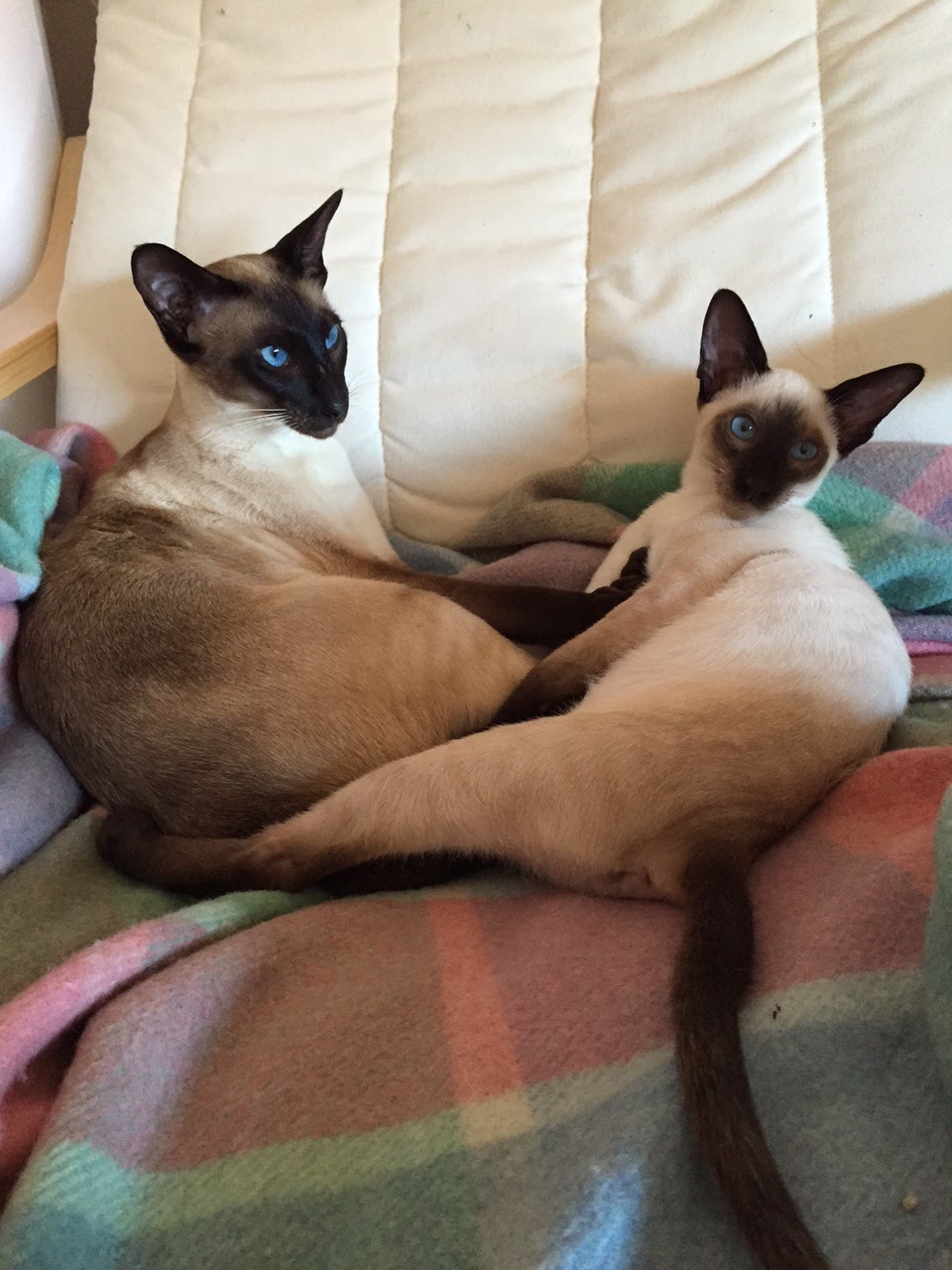
And now, because I can, one of my 'simple things' - here are my two cats. Rumi - the little one - is 4 months old, and Callie is 16 months. They're full sisters, born a year apart to the same parents. They make us laugh every day. Enjoy.


Tuesday, 22 September 2015

#RABlog Week: Post No.3 You want to know about living with RA?

Today's prompt:
Explain your RA - perhaps you want to tell someone else (doctor, sibling, child). Pick a person and decide what to tell them. You might want to tell them about living with RA or what it's like to have RA. ... You might also choose to write to a newly diagnosed person about life with RA.

Just recently, I lost one of my oldest, closest friends to ovarian cancer. (My tribute to her is HERE.) She had also been diagnosed, only a couple of years ago, with RA. I remember the conversation I had with her when she phoned me to pick my brains, so because she's very much on my mind, I'm going with that...this is pretty much what I told her when she asked me what it was like, what could she expect, and what should she do next...

Everyone's experience with RA is different because the disease can present so very differently from person to person. My first rheumatologist once said to me that if you lined up twelve people with RA, it's entirely possible that if you looked at their blood work, all twelve could be completely different. They could all be presenting very different symptoms - some might have considerable morning stiffness, others not so much. Some might have a lot of swelling in particular joints, some none at all, and some could have swelling everywhere. Some might have some involvement in joints that aren't typical for early presentation, while others have a really straightforward (if there is such a thing!) presentation of sequential changes. And THEN, there are the meds, and the different ways everyone can respond to the same medication. More on that later...
 

You need to build good solid relationships with your doctors - that's incredibly important. You'll probably be seeing a whole lot more of your GP because, ideally, your GP is the hub around whom all your other specialists revolve, and they need to be updated every time you see someone new, or something changes with your treatment. The next most important relationship you need to foster is the one with your rheumatologist. I don't know what it is, but in my twenty three year experience with this disease, I've come to realise that in a lot of cases, rheumatologists can be among the most socially inept of all medical specialists. I got lucky with my first one. And then very unlucky with a fair number in between - and I've heard some bothersome stories from other people about experiences they've had. At the moment, the doctor I have is brilliant, personable and generally easy to get along with, and that's marvelous. Maybe he's an example of a potential improvement across the speciality - I certainly hope so!

You have to trust your doctors, and that's one of the reasons you have to be able to work with them without it being a battle. You are going to get truckloads of unasked for advice from lots of well meaning, but ignorant people - as far as RA itself is concerned. At some point, you need to know that you have someone in your corner who is focused on working out the best possible treatment for you - for me, that's definitely my rheumatologist, with my GP right behind him. 

On the advice - learn to let it wash over you. Unfortunately, RA is hugely misunderstood by the majority of the general public. If I had a dollar for every time I've had someone move in on my personal space and show me their thumb or little toe and inform me that they've got arthritis there and oh boy it hurts like nothing else, so they know EXACTLY how I must be feeling, I'd be a rich woman! They mean well...I know they do, but they don't have the foggiest idea how I'm feeling. They really don't. And the people who tell you that, oh yes, their grandmother/father/great aunt 'has that', chances are, that's not the case either. What these people have is osteo arthritis - a degenerative form of arthritis that comes about through the wear and tear of a joint through age or injury. It's definitely painful and nasty, but it's isolated to specific joints, it's NOT a systemic disease. 

Another bit of advice you'll no doubt get will be about your diet, and the medications your rheumatologist will probably prescribe for you. The diet thing...you probably shouldn't get me started on diets. I could chew up some people and spit them out for the spurious diet advice they spruik, on the basis that it will CURE your autoimmune disease. It won't. OK? Know that now, and don't forget it. I wrote about this for Creaky Joints a month or so ago, so you can read that post HERE, rather than me ranting about it again now. Bottom line though, eat a healthy, well balanced diet, with as much local fresh food as possible. Stay away from processed food as much as you can. Moderate alcohol, and drink lots of water. THAT will keep you as healthy as possible - and you'll need to do that.

On the drugs... RA drugs aren't nice. Any of them. Some of them are downright nasty. But at this point in time, there is NO CURE for RA. The only thing that can be done - and this is a considerable advance on the few options that used to be available - is to administer drugs that interfere with the progression of the disease, and that minimises both symptoms and damage. Without those drugs, you risk the disease running rampant and out of control, causing irreversible damage and potentially life threatening complications at the extreme end of the spectrum. Initially, in Australia, you'll be started on DMARDs - Disease Modifying Anti Rheumatic Drugs. You have to have taken and/or failed all the available options in this class of drug for a specific period of time before you are eligible for the newest drugs - the bDMARDs - Biologic DMARDs. Biologics are made from human proteins, they're live, and they're injected or infused - although there are some really new ones, that are only available in specific trials in Australia at the time of writing, that come in tablet form. Taken in conjunction with one or more regular DMARDs, these drugs are proving to be effective for the majority of patients in slowing disease activity in some degree - some people are achieving a medical remission (i.e. no disease activity). Those are the main drugs. Others include anti-inflammatories, and a range of pain killers, supplements and different classes of drugs that are being used by pain specialists in an effort to avoid the use of opioids for pain. 


There will be people who try to dissuade you from taking these drugs - advocating a diet or alternative approach instead. Don't go there. In the very early stages of the disease, that MAY help alleviate symptoms so you'll feel better. However, it can't cure the disease, and by missing the window of early opportunity to control it with proven medical protocols, you risk it getting out of hand and doing real damage - you'll have a fight on your hands then, to come back from that, and you can't do anything about damage that's been done until it's bad enough for corrective surgery. It can sometimes take a while before you get to a combination of drugs that work for you. Sometimes the side effects can be so nasty that you have to stop a drug. Sometimes, it just doesn't work for you. You'll need to cultivate patience, and again, trust your doctor.

Stay as active as you can - that can seem counter-intuitive when you're feeling ill, you're in pain and fatigue is dragging you down. But there is good research to back up the idea that gentle consistent exercise can help moderate pain levels and give you more energy long term. Also, muscles atrophy frighteningly fast, so if you collapse onto the couch and stay there you're going to start finding it harder and harder to get up and move again. There's a well known slogan used by arthritis associations all around the world: Use it or lose it - and it's absolutely true. You don't have to train like a demon and run marathons - although, if you can, hats off to you and go for it. But, regular walking, swimming, cycling, yoga, tai chi, and other low impact activities are good for you - physically and mentally. 

Most importantly, educate yourself. Learn about the disease, learn about the drugs and how they work, read about all the diets and what the medical fraternity have to say about alternative practices. Ask your rheumatologist about things you've been reading so you know where he or she is coming from. When you visit your rheumatologist, if there's something you don't understand, ASK for an explanation. My doctor always gives me printouts of anything new he's prescribing for me so I have the information - ask for those if it's not your doctor's standard practice. In Australia, the Rheumatology Association has a website where you can access lots of information via their information sheets. You can find those on the bottom right hand corner of the home page HERE. They're excellent, free and come in printable form.

Lastly - yes, I will draw this to a close, but am happy to continue the conversation with anyone who wishes to contribute in the comments - try not to live your disease. You got sick, and that sucks. It really does. BUT, you're still you. The interests you have, the things you do, the activities you're passionate about - they're all still there. You may, over time, have to adapt how you do them, and some you may have to let go. But there will be other things you'll find that are just as interesting and that bring you joy. There may even be things that you find because you got RA that you may never have found otherwise (who'd have guessed I'd be writing for a living...?). There's another saying that I love and try to live with: I have RA, RA doesn't have me. It's worth printing that and putting it somewhere you see it all the time - for the bad times, and there will be bad times. But they will pass and there will be good times too. And I'm always here if you need to talk, ask questions, or just have a howl...so don't be a stranger.